
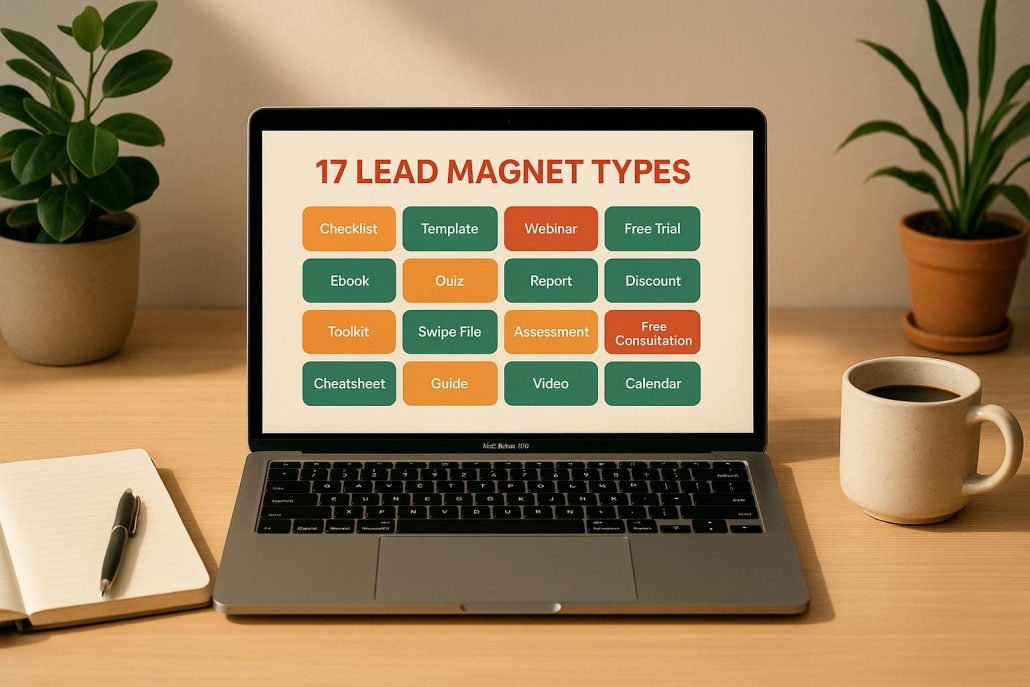
17 Lead Magnet Types and Their Use Cases
Lead magnets are free resources offered in exchange for contact details, helping businesses grow their email lists and connect with potential customers. They work by providing immediate value, such as solving a problem or offering insights, encouraging users to share their information. Here’s a quick breakdown of 17 effective lead magnet types and their best uses:
- Checklist: Step-by-step guidance for tasks or processes.
- Template: Pre-made frameworks for quick implementation.
- Ebook: In-depth content for educating readers.
- Guide: Detailed solutions for specific challenges.
- White Paper: Data-backed insights for B2B audiences.
- Case Study: Real-world examples showcasing success.
- Report: Industry trends and research findings.
- Webinar: Live or recorded sessions for interaction.
- Tutorial Video: Visual instructions for complex topics.
- Email Course: Multi-day lessons delivered via email.
- Quiz/Assessment: Personalized insights based on user input.
- Discount/Coupon: Immediate savings for purchases.
- Bundle Offer: Combined products/services at a reduced price.
- Free Trial: Hands-on access to products or services.
- Free Consultation: One-on-one sessions for tailored advice.
- Resource Library: A collection of downloadable content.
- Restricted Content: Exclusive materials gated by email signup.
Each type serves different goals, from educating prospects to driving sales. The key is to align your lead magnet with your audience’s needs and the stage of their buyer journey. For example, checklists and templates work well for quick wins, while white papers and case studies appeal to decision-makers seeking proof of value.
Quick Comparison:
| Lead Magnet Type | Best Use Case | Key Advantage | Complexity | Target Audience |
|---|---|---|---|---|
| Checklist | Step-by-step processes | Easy to create, actionable | Low | Busy professionals |
| Template | Ready-to-use frameworks | Saves time | Low-Medium | Efficiency-focused users |
| Ebook | Comprehensive education | Builds authority | High | Researchers, decision-makers |
| Guide | Step-by-step solutions | Highly actionable | Medium-High | Problem-solvers |
| White Paper | B2B decision-making | Credibility boost | Very High | Executives, professionals |
| Case Study | Proof of success | Social proof | Medium | Decision-makers |
| Report | Industry insights | Thought leadership | High | Analysts, executives |
| Webinar | Interactive education | Builds trust | Medium | Engaged learners |
| Tutorial Video | Visual learning | Highly engaging | Very High | Visual learners |
| Email Course | Gradual education | Builds relationships | Medium-High | Learners, researchers |
| Quiz/Assessment | Personalized insights | High engagement | High | Curious users |
| Discount/Coupon | Immediate sales | Easy to implement | Low | Price-sensitive shoppers |
| Bundle Offer | Value perception | Increases order value | Medium | Value-seekers |
| Free Trial | Product experience | Risk-free exploration | Low-Medium | Cautious buyers |
| Free Consultation | Tailored advice | Builds trust | Low | High-intent prospects |
| Resource Library | Ongoing value | Multiple touchpoints | High | Researchers, professionals |
| Restricted Content | Exclusive access | Scarcity appeal | Medium | Qualified leads |
The most effective lead magnets are those that offer immediate, actionable value while aligning with your audience’s needs. Start small with low-effort options like checklists or templates, then expand to more complex formats like webinars or reports as your strategy evolves.
Types of lead magnets and examples
1. Checklist
A checklist is one of the easiest and most practical lead magnets you can create. It walks your audience through a series of clear, step-by-step instructions to achieve a specific goal.
Checklists are straightforward and effective. They don’t require much reading, making them quick to understand and act on.
Best Use Cases
Checklists shine when your audience needs to follow a process with multiple steps. They’re ideal for onboarding new customers, preparing for events, or navigating complex procedures. For example, a web design agency might offer a "Website Launch Checklist" covering everything from setting up a domain to optimizing for search engines.
For service-based businesses, checklists are especially useful. They showcase expertise while offering immediate value. A marketing consultant, for instance, could create a "Social Media Audit Checklist" to help companies evaluate their online presence.
Digital marketing agencies, like Green Forest Marketing, often use checklists to outline campaign steps, making the process easier for clients to follow.
Checklists also work well as content upgrades – lead magnets tailored to specific blog posts. For instance, if you’ve written about email marketing, offering an "Email Campaign Setup Checklist" as a downloadable resource can significantly boost opt-ins.
Target Audience
Checklists appeal to people who prefer clear, structured guidance over lengthy explanations. They’re perfect for busy professionals who want to ensure they don’t miss any critical steps in important processes. By providing a systematic approach, checklists help users feel in control and accomplished as they check off tasks.
Value Provided
"In our experience, checklists convert the best quality leads out of all the lead magnet types. This is because they are easy to create and consume, and are low-commitment. They eliminate guesswork and prospects get their value right away." – Mariana Lessmann, Author at Growbo
Checklists offer immediate, actionable value. Unlike ebooks or guides that require more time to digest, checklists provide a clear plan of action that users can begin following right away. Plus, the act of checking off tasks boosts motivation and gives a sense of progress.
Ease of Implementation
Creating a checklist is simple. All you need is a solid understanding of the process your audience needs to complete.
For added impact, consider making your checklist interactive. Clickable checkboxes and a progress tracker that updates as users complete tasks can make the experience more engaging and memorable. Growbo.com even reported that their checklist helped them gain over 21,068 subscribers, proving how effective this format can be.
Up next, let’s dive into how templates can simplify your customer’s journey even further.
2. Template
Templates provide your audience with a ready-made framework that can be tailored to meet their specific needs. Instead of starting from scratch, users get a structured document that saves time and eliminates guesswork. They act as the backbone for various projects, offering a clear starting point.
Best Use Cases
Templates shine when your audience frequently creates similar documents or follows repetitive workflows. They’re especially useful for businesses striving for consistent formatting across materials or for professionals aiming to streamline their processes.
Take HubSpot, for example. On their blog about lead magnets, they offer over 150 content creation templates as a free downloadable resource. Visitors simply share their contact details to access these tools, making it a win-win for both parties.
Similarly, the collaboration platform Mural offers hundreds of templates designed to help teams tackle problems together. Users can explore these templates by signing up for a free account.
Target Audience
Templates are a hit with busy professionals and business owners who value efficiency and quality. They’re ideal for individuals who may not be experts in a given area but still need polished, professional results. These users want tools that save time, ensure consistency, and eliminate the need to reinvent the wheel for every new project.
Value Provided
Templates simplify complex tasks by breaking down information into manageable chunks. They use elements like bullet points, headers, and visuals to highlight key details.
The real strength of templates lies in their proven track record. Content writer Jairene Cruz captures this perfectly:
"Templates provide proven conversion formulas. Instead of guessing what works, templates provide blueprints based on successful lead capture strategies, enabling you to launch faster while achieving better results."
By offering a clear structure, templates improve messaging consistency and boost the chances of generating high-quality leads. They take the frustration out of starting from zero, guiding users toward professional outcomes with ease.
Ease of Implementation
To create impactful templates, start by understanding your audience’s specific challenges and workflows. Collaborate with your sales and customer service teams to identify the pain points your customers face most often.
Design templates that are relevant, well-branded, and packed with actionable tips and industry insights. Use your expertise to craft a tool that feels like having a personal guide, making even the most daunting tasks approachable and achievable.
Ready to explore another lead magnet that can elevate your strategy? Let’s move on to the next type.
3. Ebook
Ebooks are detailed publications that dive deep into specific topics, offering readers valuable insights in exchange for their contact information. Unlike shorter lead magnets, ebooks provide thorough knowledge that not only helps solve complex problems but also positions your business as a trusted industry leader.
Best Use Cases
Ebooks are particularly effective during the early stages of the buyer journey, when potential customers are researching their challenges. In fact, 48% of buyers find ebooks helpful at this stage. They’re ideal for capturing early leads, especially in industries where products or services are complex or expensive, requiring buyers to educate themselves before making decisions.
Ebooks can also be valuable during the middle stage of the buyer journey. Including detailed case studies or reports helps prospects evaluate their options more thoroughly.
For instance:
- Gentleman’s Gazette attracts men’s fashion enthusiasts with an ebook titled "50 Style Mistakes", offering practical style advice.
- Springly, a nonprofit software company, uses ebooks to address the unique challenges nonprofits face, building their email list in the process.
Target Audience
Ebooks resonate with readers who prefer detailed, well-researched content over quick summaries. Surveys show that 59% of respondents favor ebooks as a content format, and 51% consider them the most effective type of content. This makes them especially appealing to professionals and decision-makers who value expertise and depth.
Value Provided
Ebooks serve multiple purposes: they educate, build trust, and enhance brand visibility . Their in-depth nature allows businesses to address specific topics and connect meaningfully with their audience, no matter where they are in the buying process.
For example:
- Proposify repurposed four years’ worth of blog posts and podcast interviews into a 175-page ebook that helps agencies scale their business. This ebook generates hundreds of qualified leads each month, with 83% of them being high-quality prospects.
Additionally, ebooks are cost-efficient. Once created, they require minimal ongoing investment but continue to deliver results. Experts highlight ebooks as a unique tool for combining thought leadership, client education, and lead nurturing.
Ease of Implementation
Creating an effective ebook might seem daunting, but breaking the process into manageable steps can simplify the task:
- Outline Your Content: A clear structure helps streamline the writing process.
- Repurpose Existing Content: Use your best-performing blog posts or articles as a starting point.
- Align with Your Brand: Ensure the ebook reflects your company’s style by using cohesive visuals, graphics, and headings to keep it engaging .
- Stay Focused: Limit the ebook to 5–20 pages and center it around solving one specific problem.
- Include Calls-to-Action: Guide readers on what to do next.
- Promote Strategically: Publish the ebook in an easy-to-access format like PDF and share it through email campaigns, social media, and landing pages.
- Track Performance: Monitor downloads and conversions to refine your strategy.
With 55% of small businesses reporting success using ebooks as lead magnets, investing time in creating a well-crafted ebook can pay off significantly. Up next, we’ll explore another effective lead magnet.
4. Guide
Guides provide step-by-step solutions to specific problems, delivering quick results while showcasing your expertise.
Best Use Cases
Guides take the concept of checklists and templates a step further by offering in-depth solutions to specific challenges. They’re particularly effective when you’ve pinpointed a niche and created content that addresses a specific problem your audience faces. This format is ideal for businesses looking to demonstrate their expertise while providing immediate value to potential customers. The goal? Solve a problem quickly and effectively.
For instance, Larry Law Law offers an Ultimate Guide for Law School Success, and KlientBoost pairs a free PPC strategy guide with related blog posts. These examples highlight how guides can provide instant solutions to pressing issues, making them a go-to resource for audiences seeking actionable advice.
Target Audience
Guides appeal to individuals actively searching for solutions or insights. These are people ready to invest their time in learning if it means resolving their challenges. By analyzing your audience, you can tailor your guide’s content to meet their needs, making it more engaging and relevant.
"Tailoring your content to match your target audience’s needs is more than just an SEO tactic – it’s about building relationships."
The most engaged readers are often professionals and decision-makers who value detailed, actionable information over superficial content. They’re typically in the research phase of their buyer journey and appreciate resources that help them make informed decisions.
Value Provided
Guides are a powerful way to address pain points while offering actionable advice. They not only position your business as an authority but also provide immediate value that prospects can apply right away. The most effective guides solve a specific problem, offer instant results, and deliver high value. Including data, statistics, and real-world examples can further enhance credibility and make your guide more actionable.
For example, segmentation can boost revenue by up to 760%. This highlights the importance of creating targeted guides for specific audience segments, which can significantly improve lead generation. When your guide focuses on solving one problem exceptionally well, it becomes far more impactful than generic content.
Ease of Implementation
Creating guides doesn’t have to be complicated, especially for small businesses. You can repurpose existing content or hone in on a specific problem within your expertise. Start by identifying your audience’s pain points, then craft a concise guide that delivers on its promise. Setting up an opt-in funnel with a landing page, form, thank-you page, and automated email ensures a smooth implementation process.
Many businesses have successfully used guides as lead magnets. For example, Blooming Design Co. offers a password-protected walkthrough guide on creating a link-in-bio page, with access provided via automated email through Flodesk. Similarly, The Laurie Loo delivers a guide for cleaning out a closet in one day, offering immediate solutions to a common problem. Tools like Canva, Google Docs, and email marketing platforms make it easier to create and share guides. The key is to ensure your guide delivers genuine value while being easy to understand and implement.
Up next, let’s explore another lead magnet that builds on these principles.
5. White Paper
White papers are detailed, authoritative documents designed to position your business as a leader in your field by tackling complex industry issues and offering data-backed solutions.
Best Use Cases
White papers shine brightest in B2B marketing, especially as tools for engaging prospects in the middle of the sales funnel. They are perfect for presenting original research, comprehensive analysis, and expert viewpoints, helping readers move from identifying a problem to understanding actionable solutions.
"A whitepaper is a persuasive, authoritative, in-depth report on a specific topic that presents a problem and provides a solution." – Lindsay Kolowich
Target Audience
The primary audience for white papers includes decision-makers and influencers – such as executives, department leaders, and technical experts – who are actively searching for in-depth insights to guide their choices. These professionals value educational content they can share within their organizations. In fact, 79% of B2B buyers say white papers are the type of content they’re most likely to share with colleagues.
Value Provided
White papers combine education with strategic insights to influence purchasing decisions. For instance, 76% of B2B decision-makers rely on white papers when making purchase choices, and 78% have used them as a primary research resource. Additionally, buyers who engage with white papers tend to spend 40% more on subsequent purchases. White paper downloads also convert to sales opportunities at a rate of 7%, outperforming blog subscribers (4%) and webinar attendees (3%). Among C-suite executives, 84% report that white papers influence their decisions, and 71% share them internally. Striking a balance – 80% educational content and 20% promotional – further establishes credibility.
Ease of Implementation
While creating white papers is more resource-intensive than simpler content types, the payoff is higher-quality leads and better conversion rates. To simplify the process, repurpose existing content and use AI tools for drafting, followed by expert editing. A strong white paper typically includes an executive summary, a clear problem statement, a solution framework, and practical recommendations. Supporting your narrative with solid research, expert interviews, and industry benchmarks adds credibility.
For example, in October 2024, Shopify released a 12-page white paper titled "Path to a Performant Checkout", which explored factors for optimizing e-commerce checkout flows. This document combined detailed data, practical examples, and actionable advice, delivering immediate value to its audience.
Effective distribution amplifies the impact of a white paper. According to NetLine Corporation in 2024, industry-specific distribution increased white paper engagement by 4.2x. To maximize reach, promote your white papers through targeted email campaigns, social media, paid search, and content syndication.
At Green Forest Marketing, we specialize in crafting white papers that establish authority and drive high-quality leads. By combining efficient production with targeted promotion, we help businesses refine their lead generation strategies and achieve measurable results.
6. Case Study
Case studies provide a practical way to back up your claims with real-world examples, adding credibility and reinforcing trust. By turning customer success stories into detailed narratives, they show how you’ve effectively solved client challenges.
Best Use Cases
Case studies are particularly effective for B2B lead generation, where decision-makers often seek concrete evidence that a solution delivers results. They help bridge the gap between awareness and decision-making by offering detailed success stories.
These assets shine when you need to build trust quickly or highlight specific outcomes. For example, AdEspresso uses downloadable case study PDFs to provide deeper insights, directing users to landing pages with lead capture forms. Similarly, CoSchedule creates downloadable case studies with clear calls-to-action, such as demo requests.
They’re also ideal for explaining complex solutions or promoting high-value services, where prospects require substantial proof before committing.
Target Audience
Case studies resonate most with decision-makers who need evidence to justify their choices. This group includes executives, department heads, and technical professionals responsible for presenting solutions to their teams or stakeholders.
The key is to address shared pain points and demonstrate that you’ve successfully tackled similar challenges for others. This makes your case studies relatable and impactful for your target audience.
Value Provided
Case studies offer a level of credibility that few other content types can match. Research indicates that 78% of B2B buyers consult case studies when making purchasing decisions, while 73% of top-performing content marketers rely on them.
Unlike simple testimonials, case studies focus on proof rather than promises, often leading to higher conversion rates. They also help shorten the buyer’s journey by building trust quickly. For instance, ONESOURCE used a case study featuring The Cheesecake Factory to present clear, organized content that addressed potential clients’ needs, directly influencing purchasing decisions.
This ability to showcase real results makes case studies a powerful tool for driving leads and sales.
Ease of Implementation
Creating a case study involves a moderate level of effort. The process typically includes interviewing customers, documenting their challenges and outcomes, and crafting a data-driven narrative.
To make your case studies compelling, focus on storytelling. Introduce characters and conflicts, be specific with data, include customer quotes, and conclude with a strong resolution. Highlight the business challenges your clients faced, the strategies you implemented, and the measurable results achieved.
For example, Disruptive Digital incorporates case studies into their blog posts, offering clear evidence of their expertise and the success of their methods. This approach ties case studies to relevant topics, making them more engaging and relatable.
To maximize their impact, distribute your case studies across multiple channels. Make them accessible on your website, optimize for search engines, and offer downloadable PDFs for lead generation. Repurpose the content into blog posts, social media updates, email campaigns, and even webinars.
At Green Forest Marketing, we specialize in creating concise, results-driven case studies that highlight client success and build trust with prospective leads. By documenting achievements clearly and effectively, we help businesses showcase their capabilities and drive meaningful engagement.
7. Report
Reports are a go-to resource for decision-makers who need detailed insights, data, and trends to make informed choices. Unlike shorter content formats, reports provide an in-depth exploration of topics, making them essential for strategic planning.
Best Use Cases
Reports shine when you need to present original research or conduct a deep dive into industry trends. They are particularly effective in B2B lead generation, where prospects often require substantial data and analysis before committing to a decision. By offering well-researched insights, reports position your brand as a trusted authority, giving your audience the sense that they’re gaining insider knowledge.
For example, Search Engine Journal’s "State of SEO Trends for 2025" report acts as a guide for digital marketers navigating the evolving SEO landscape. This type of content not only addresses pressing industry needs but also reinforces credibility and expertise.
Another advantage of reports is their shareability. Their comprehensive nature makes them ideal for generating media interest and driving social media engagement, helping your brand reach audiences far beyond your immediate network.
Target Audience
Reports resonate most with decision-makers who rely on thought leadership and solid data to guide their strategies. This includes executives, department heads, and technical professionals tasked with presenting well-researched solutions to their teams or stakeholders. To maximize impact, it’s critical to understand the specific challenges and needs of these groups, especially in industries where detailed research carries significant weight.
Tailoring your report to different audience segments can enhance its relevance. A great example is the Resuscitation Academy’s eBook, "Ten Steps for Improving Survival from Sudden Cardiac Arrest." This targeted approach ensures the content addresses the unique concerns of its intended readers, making it more impactful.
Value Provided
Reports deliver immense value by offering unique data, actionable insights, and expert perspectives. According to research, 49.2% of marketers find reports effective for boosting conversion rates. Their depth not only helps build trust but also demonstrates your expertise, making them an excellent tool for lead generation.
Well-crafted reports can also serve as long-term assets. They continue to generate leads over time, providing a lasting return on your investment. By offering actionable information that prospects can immediately use, reports strengthen your credibility and foster trust.
Ease of Implementation
Creating impactful reports requires significant effort, from conducting thorough research to analyzing data and presenting findings in a clear, digestible format. To make the information more accessible, consider incorporating infographics and visuals that highlight key insights.
HubSpot’s experience with its HubSpot Creators Program is a testament to the power of data-driven reports. In 2024, the program reduced the company’s cost per lead by 30% to 40% compared to Google and Meta ad costs. It also engaged 100 creator partners and increased media network demand and reach by 50%. This example underscores how well-executed reports can drive meaningful business results.
By addressing real challenges and offering practical solutions, you can transform a report into a valuable tool that prospects are eager to access – often providing their contact information in exchange.
At Green Forest Marketing, we specialize in helping businesses create comprehensive reports that showcase expertise and generate high-quality leads.
8. Webinar
Webinars bring a unique advantage by offering live interaction and real-time engagement. They create a two-way conversation, allowing you to address questions immediately while building meaningful connections with your prospects.
Best Use Cases
Webinars are perfect for showcasing expertise and building trust. Whether you’re running product demonstrations, sharing educational content, or establishing thought leadership, webinars can be a powerful tool. Did you know that 91% of B2B professionals prefer webinars? Companies like Clearscope and Zapier are great examples of how live sessions can effectively generate qualified leads.
For instance, Clearscope hosts webinars on SEO topics like keyword gap analysis, attracting marketers and positioning itself as a leader in the industry while gaining qualified leads. Similarly, Zapier frequently organizes live webinars to teach audiences how to maximize automation tools, seamlessly connecting their expertise with their product offerings.
To maximize attendance, start promoting your webinar two weeks ahead and send personalized reminder emails. The key is to choose topics that address your audience’s specific challenges or goals.
Target Audience
Webinars can serve different purposes depending on your audience. For lead generation, focus on individuals seeking solutions and educational content. For sales conversion, target those already familiar with your brand by offering in-depth demonstrations or advanced training.
It’s essential to understand your audience’s demographics, interests, and pain points. Developing detailed buyer personas helps tailor your content to meet their needs. Keep in mind that 63% of webinar views happen on-demand, so offering a recorded option is crucial.
Value Provided
Webinars offer an impressive level of engagement, with an average attendee conversion rate of 55%, and 73% of attendees becoming qualified leads. On average, participants spend about 53 minutes per session, giving you ample time to build relationships and trust. Beyond lead generation, webinars also help align marketing and sales efforts.
Another bonus? Webinar content can be repurposed into blog posts, social media updates, or other marketing materials, extending its value far beyond the live event.
Ease of Implementation
While webinars require more effort than static content, proper planning makes them manageable. The focus should always be on delivering genuine value rather than pushing a hard sell. Simplify the registration process, include interactive elements like polls and Q&A sessions, and provide takeaway materials. Recording sessions for on-demand access extends your reach, and personalized follow-ups can help convert attendees into quality leads.
"The key is providing genuine value to your audience instead of relying on dull slide decks".
Engagement is the most critical factor. Segment your audience based on their interaction levels and use a lead scoring system to prioritize the most promising prospects.
At Green Forest Marketing, we specialize in helping businesses design webinars that not only educate but also drive high-quality leads through strategic content planning and follow-up campaigns.
Up next: discover how tutorial videos can take your lead generation strategy even further.
9. Tutorial Video
Tutorial videos are a great way to simplify complex ideas by showing, rather than just telling. They break down technical details into digestible steps, making it easier for viewers to follow along.
Best Use Cases
Tutorial videos shine when explaining technical processes or showcasing product features. A good rule of thumb? Dedicate 20% of the video to defining the problem your product or service solves. This helps viewers understand why they need the solution before diving into the "how".
Take Growbo as an example. They created a demo video for their Done-For-You sales funnel service. The results? Since launching the video on November 2nd, 129 viewers opted in to watch it, and 3 booked a call to learn more about their offering.
Target Audience
These videos are perfect for visual learners and those who prefer hands-on, step-by-step guidance over reading instructions. In fact, YouTube users are three times more likely to watch a tutorial video than to read a product manual.
Your audience likely includes people actively researching solutions to specific problems. These viewers are often in the early stages of their buying journey, looking for educational content to guide their decisions. To create tutorials that resonate, identify their most pressing questions – use search data or engage with your community to find out what they’re struggling with.
Value Provided
Tutorial videos do more than just explain – they position you as a helpful resource. By walking viewers through technical details in a clear and approachable way, you build trust and demonstrate your expertise. Even if someone isn’t ready to buy, they’ll remember you when the time comes because you’ve already added value.
Consider this: 45% of people watch at least an hour of video content every week on platforms like YouTube and Facebook. That’s a huge opportunity to connect with viewers and make your tutorials part of their routine.
Ease of Implementation
While creating tutorial videos takes some planning, it’s easier with a clear structure. Focus on addressing your audience’s challenges, add compelling call-to-action buttons, include social proof, and use simple, relatable language.
These videos are incredibly versatile. You can repurpose them for email campaigns, social media, or even as part of a larger content strategy. At Green Forest Marketing, we’ve seen how well-crafted tutorial videos not only educate but also build trust and drive high-quality leads through thoughtful planning and follow-up strategies.
sbb-itb-0a5855c
10. Email Course
Email courses are a powerful way to engage potential customers over time while offering valuable, targeted content. Delivered through automated emails over several days or weeks, these courses help build meaningful connections with your audience.
Best Use Cases
Email courses are great for testing interest in a product and showcasing your expertise. For example, Jason Logsdon’s 7-lesson course, Sous Vide Quick Start, takes beginners from knowing nothing about sous vide cooking to feeling confident in the kitchen – all while positioning him as a trusted authority in the space.
They also shine when addressing specific professional challenges. Luke Cannon’s courses, like Maximizing LinkedIn to Work for YOU and From Rejection to Killer Resume, directly tackle common career obstacles, making them highly relevant for professionals looking for actionable solutions.
Target Audience
Email courses work best for people who are actively looking for practical, actionable advice in your area of expertise. These subscribers appreciate the convenience of self-paced learning that fits into their busy lives and are often in the early stages of exploring their options.
Value Provided
The step-by-step format of an email course allows you to demonstrate your knowledge consistently. Each email dives into a specific topic, helping to establish your credibility. The potential impact is impressive: one food blogger reported 10,000 sign-ups in the first year of their course, with 8,000 subscribers completing all 20 lessons. Even more striking, 43% of those who finished opened the final email.
This level of engagement makes email courses an effective tool for building trust and delivering measurable results.
Ease of Implementation
Creating an email course is simpler than it might seem. Start by breaking your expertise into 5–7 lessons, each focusing on a single topic. Define a clear goal for your subscribers – what will they achieve by the end of the course? Then, work backward to map out a logical learning path. Your first email should grab attention and provide immediate value, while including small tasks or assignments early on can turn passive readers into active participants.
To automate the process, choose an email service provider like Constant Contact, ConvertKit, or Drip. Use subject lines that clearly indicate the lesson number and give a sneak peek of the content.
At Green Forest Marketing, we’ve found email courses to be an excellent way to maintain long-term relationships with clients by delivering consistent, helpful information.
11. Quiz or Assessment
Quizzes are a unique way to combine entertainment with personalization, making them stand out from more traditional lead magnets like static PDFs. They actively engage your audience, offering them insights about themselves while keeping the experience fun and interactive.
Best Use Cases
Quizzes are fantastic tools for pre-qualifying leads and gathering detailed customer insights before any direct interaction. For example, Boot Camp Digital uses a digital marketing assessment to evaluate marketers’ skills and tailor services accordingly. CEO Krista Neher shares:
"We’ve been running the campaign for years now, and we’ve had thousands of people completing it. This campaign is the highest converting lead magnet that we’ve ever done, by far."
Similarly, Lynn from Wild Fleurette, a wedding florist, uses a quiz to help clients discover their ideal bridal bouquet style. The quiz not only saves her time but also creates a more personalized experience right from the first consultation.
Quizzes also excel at recommending products. For instance, Undersun Fitness asks customers about their goals, experience, and workout preferences, then suggests the best fitness solution and even offers a $10 discount code. Amelia Gray Skincare uses a similar approach, asking questions about skin texture and pore description before offering personalized product recommendations in exchange for an email address.
Target Audience
Quizzes appeal to people seeking quick, personalized insights. These individuals are often in the early stages of exploring solutions and prefer an interactive format over lengthy content. They’re willing to spend a few minutes answering questions if it means receiving tailored recommendations or actionable assessments.
This format works particularly well for busy professionals who value efficiency. Whether someone wants to identify their leadership style, assess their marketing skills, or find the perfect skincare routine, quizzes provide instant results while helping clarify their needs.
Value Provided
Quizzes boast impressive conversion rates – typically 30–50%, compared to the 3–10% seen with static PDFs. They can generate five times more engagement and twice the conversions of static content.
Real-world examples highlight their effectiveness. Brand strategist Kaye Putnam generated over $100,000 in online course sales using a quiz, while Jen from TONIC Site Shop made $50,000 in website template sales with a free quiz. David Fraser of Bunkie Life used a readiness test to educate potential customers about log cabins, tripling his revenue in just one year.
Beyond conversions, quizzes provide valuable data for future marketing efforts. They reveal audience trends, highlight content gaps, and identify common challenges your prospects face. This information can guide more focused campaigns and even inspire new product ideas.
Ease of Implementation
To create a successful quiz, start by identifying a key challenge your audience wants to solve or an area they’re eager to improve. Plan the results first to ensure the questions align with your offerings and stay focused.
Keep the quiz short – ideally 5–10 questions that take under three minutes to complete. Offer 3–5 engaging and valuable questions before asking for contact details. This builds trust and increases the chances of participants sharing their email addresses.
Most quiz platforms let you customize the design to match your brand, allowing you to add logos, colors, and other stylistic elements. The real magic lies in crafting personalized results pages that deliver actionable insights, not generic feedback.
At Green Forest Marketing, we’ve seen how quizzes can revolutionize lead qualification. By providing meaningful insights about prospects upfront, follow-up conversations become far more targeted and effective.
12. Discount or Coupon
Discounts and coupons tap into a universal desire: saving money. Unlike educational content that takes time to digest, discounts provide instant value – something prospects can quickly understand and act on.
Best Use Cases
Discount lead magnets are particularly effective for e-commerce businesses and brands selling physical products. They’re a great way to win over hesitant buyers who are interested in your product but holding out for a better deal.
For instance, beauty and skincare subscription service Birchbox offers first-time shoppers 20% off their first purchase. This approach lowers the price hurdle, encouraging customers to try the service without committing to the full price upfront.
Similarly, La Senza uses discount codes as lead magnets with direct messaging like, "Want to save money? Sign up and get 20% off!". This simple yet effective strategy appeals to the 94% of customers who actively seek exclusive offers.
Timing also matters. Consider releasing coupons during high-demand shopping periods, like Black Friday or the holiday season, when consumers are already hunting for deals. Another powerful tactic is offering discounts on new product launches to generate buzz and drive early sales.
Target Audience
Discount lead magnets resonate most with price-conscious shoppers – those who actively compare prices and hunt for deals before making a purchase. These shoppers are often willing to exchange their email address for exclusive savings, especially if the offer feels limited or special.
This strategy is especially effective for businesses selling products that encourage repeat purchases. Since most online shoppers look for discounts before completing a transaction, offering an exclusive coupon can tip the scales in your favor.
Value Provided
Coupons are highly effective at driving conversions, with average rates hovering around 20%. Their power lies in the immediate, measurable savings they offer. Beyond the dollar amount, discounts create a sense of exclusivity and urgency – particularly when paired with limited-time offers. This combination can nudge hesitant buyers to take action sooner rather than later.
For businesses, discounts generate sales-ready leads, as customers who sign up for a coupon are often ready to make a purchase. This shortens the path from lead to sale, making it an attractive option for companies focused on quick revenue growth.
Ease of Implementation
Setting up discount codes is straightforward, especially with most e-commerce platforms offering automated tools for delivery. The key is to make the offer feel exclusive and urgent. Use language that highlights the special nature of the deal, and include clear expiration dates to prompt immediate action. Pop-ups offering a discount as soon as visitors land on your site can also be highly effective.
When deciding on the discount amount, strike a balance: it should be enticing enough to drive action but still sustainable for your profit margins. For higher-priced items, even a smaller percentage can translate into meaningful savings for the buyer.
At Green Forest Marketing, discount offers have consistently proven to grow email lists and boost immediate sales, underscoring their value as part of a well-rounded lead generation strategy.
13. Bundle Offer
Bundle offers bring together multiple products or services at a discounted price, giving customers more value compared to buying items individually. Unlike single-item discounts, bundles encourage shoppers to purchase more while feeling like they’re getting a better deal.
Best Use Cases
Bundles are a smart way to increase average order value and move inventory that might not sell as quickly. They work especially well when combining complementary products or services. For example, Copyblogger saw email signups skyrocket by nearly 400% after offering a bundle of valuable content resources in exchange for email addresses. Similarly, e-commerce brands often use seasonal bundles to great effect. Examples include Smartish’s accessory packages, Snowe’s 20%-off bath towel deal, and Little Sleepies’ curated gift bundles.
Target Audience
Bundle offers are particularly appealing to shoppers looking for the best value and a simpler buying experience. These deals often resonate with gift buyers, parents shopping for children, or anyone making larger purchases where savings feel more impactful. Interestingly, 93% of customers prefer Buy One Get One (BOGO) bundles. Bundles can also serve as a great introduction to your brand, allowing first-time customers to try multiple products at a reduced risk.
Value Provided
Bundles provide immediate savings while simplifying the shopping process. For businesses, they can significantly boost revenue, accounting for 10–30% of e-commerce sales. Bundles also create a sense of exclusivity, especially when marketed as limited-time offers, such as Sephora’s seasonal "Limited Edition" beauty bundles. This combination of financial benefit and perceived exclusivity makes bundles a win-win for both customers and businesses.
Ease of Implementation
Setting up effective bundles starts with analyzing sales data to find products that are often purchased together. Most e-commerce platforms make it easy to create bundle pricing. To maximize impact, highlight the savings with bold visuals and clear messaging. Mango, for instance, excels at this by offering pre-styled outfits that showcase the total value. Experimenting with different product pairings, discount structures, and incorporating bundles into cart abandonment emails can also help recover lost sales.
At Green Forest Marketing, we’ve seen bundle strategies work across industries, especially when paired with email campaigns that emphasize the exclusivity and urgency of the deals. This approach fits seamlessly into broader lead generation efforts.
14. Free Trial
Free trials give users the chance to experience your product or service firsthand without any upfront payment. Unlike discounts or coupons that merely lower the cost, free trials completely remove the financial barrier for a limited time, allowing potential customers to explore your offering in depth before committing.
Best Use Cases
Free trials are particularly effective for SaaS products, digital platforms, and subscription-based services – especially those that are higher-priced or more complex. They allow users to experience the product’s benefits directly, which can be a game-changer for conversion rates.
Take MUBI, for example. This film streaming service offers a 30-day free trial exclusively for students, creating a sense of exclusivity that resonates with their target audience. Similarly, teach:able encourages users to sign up by making their platform easy to explore through a straightforward call-to-action and a seamless sign-up process.
However, free trials work best when your product can demonstrate value quickly. If your offering requires weeks to show results or has a steep learning curve, this approach might not be as effective.
Target Audience
Free trials are especially appealing to cautious buyers – those who like to shop around or need internal approval before purchasing. They also work well for B2B customers. In fact, one study found that free trials contribute to 66% of B2B conversions.
Value Provided
The biggest advantage of a free trial is that it eliminates risk. Users can test features, explore functionality, and see if the product meets their needs – all without spending a dime. This builds trust and confidence in your offering.
"As it becomes increasingly challenging to get heard as a product or service in a crowded online space, one of the most powerful methods we’ve identified is offering 30-day free trials. By providing potential customers with an extended period to explore and integrate a product, businesses and digital creators can significantly boost engagement and conversion rates. This approach allows users to fully understand the value a product brings to their lives." – Cameron Zoub, CGO and co-founder of Whop
Data backs this up: 30-day free trials are nearly four times (273%) more likely to convert users than 14-day trials. Free trials also outperform free products by a factor of 28 when it comes to driving conversions.
Ease of Implementation
Launching an effective free trial involves more than just waiving payment requirements. A strong onboarding process is key. This might include personalized emails with tips, feature highlights, and usage suggestions to help users get started.
A shorter trial period, like 14 days, can create urgency. However, if maximizing conversions is your goal, research shows that 30-day trials are much more effective, converting nearly four times as many users as shorter trials. Use tools like in-app notifications, tutorial emails, and proactive customer support to ensure users see value early on.
At Green Forest Marketing, we’ve seen the best results when free trials are paired with targeted email campaigns. These sequences guide users through their trial, helping them uncover features that match their specific needs. This approach not only enhances the trial experience but also integrates seamlessly into broader lead generation strategies, turning engaged users into loyal customers.
15. Free Consultation
Offering free consultations is an effective way to build trust and provide tailored insights to potential clients. These one-on-one sessions allow you to connect personally, demonstrate your expertise in real time, and address the unique needs of each prospect. This personalized approach can be a game-changer for businesses looking to convert leads into loyal customers.
Best Use Cases
Free consultations shine in industries where trust and customization are essential, such as coaching, consulting, legal services, and marketing. They work especially well for complex offerings that require a deeper understanding of client needs.
The timing of your offer matters. Consultations are most impactful toward the end of the buying cycle when prospects are actively searching for solutions. For instance, a leading New York advertising agency offers free 15-minute brand audits and boasts an impressive 80% conversion rate into paying clients. This demonstrates how well-timed consultations can drive conversions.
In fact, a survey found that nearly half of respondents consider free consultations a key factor when selecting a lawyer.
Target Audience
Free consultations are particularly appealing to prospects who are close to making a purchase decision and are actively exploring services like yours. These leads tend to be more qualified because scheduling a consultation requires a higher level of commitment compared to downloading a guide or watching a video.
Your ideal audience includes cautious buyers who prefer to evaluate your expertise before making a significant investment. They’re often dealing with complex challenges that demand customized solutions rather than generic advice.
Value Provided
For businesses, free consultations serve as a low-risk way to engage potential clients while building trust and credibility. They help you qualify high-value leads, showcase your expertise, and gain insights into customer needs – all of which contribute to better conversion rates.
For prospects, consultations offer a no-pressure opportunity to receive expert advice and explore their options. It’s a chance to gauge your skills, understand what you bring to the table, and build confidence in your ability to meet their needs – all through a personal interaction.
Ease of Implementation
To maximize the effectiveness of your consultation offer, clearly communicate what’s included and the value clients can expect.
Craft a compelling consultation page with the following elements:
- A friendly headshot
- A concise bio
- Testimonials from satisfied clients
- A simple scheduling tool
Keep the booking process straightforward with an easy-to-use form and follow up with confirmation emails. Use a brief questionnaire to gather details about your prospect’s needs in advance, allowing you to tailor the session to their specific challenges.
During the consultation, focus on diagnosing the client’s problems rather than offering free solutions. Highlight why your services are the right fit, what they can achieve by working with you, and how you’ll deliver those results. This keeps the conversation results-oriented and professional.
At Green Forest Marketing, we’ve discovered that free consultations are most effective when paired with other lead magnets that first establish familiarity. By warming up your audience, you make them more comfortable scheduling time with you and ensure they arrive ready to discuss their goals and challenges.
16. Resource Library
A resource library acts as a central hub where you can store and organize all your downloadable content – think eBooks, white papers, videos, case studies, and guides – in one easy-to-access spot. By consolidating your lead magnets in one place, you make it simple for prospects to find and choose the resources they need.
This approach transforms your content into a 24/7 lead generation machine. In fact, 72% of websites with resource libraries collect contact details for 85% of their downloads, making this strategy a smart way to grow your leads.
Best Use Cases
Resource libraries work particularly well for businesses with extensive content catalogs and diverse audiences. If you have multiple lead magnets tailored to different buyer personas or stages of the customer journey, this setup is ideal.
Take the Open Contracting Partnership, for example. Their resource center includes research papers, reports, infographics, case studies, tools, training materials, and methodologies. Users can filter through categories to quickly find what they need.
Service-based businesses can also benefit by using resource libraries to showcase expertise in various areas. For instance, What Works in SEND features evidence on service improvements and practice models, with resources sorted by strength, theme, and project status.
Another advantage? Resource libraries can breathe new life into older content. Lead magnets that might not be actively promoted anymore can still generate leads when organized in a searchable library.
Target Audience
This format appeals to prospects who like to dig into research before making decisions. These self-starters often compare resources and gather information before reaching out to your sales team.
Resource libraries attract visitors at all stages of the buyer’s journey. Early-stage prospects might look for general educational materials, while those closer to making a decision often download specific case studies or in-depth guides. Busy professionals especially appreciate the ability to filter and quickly find what they need – 68% of resource libraries include filtering tools to enhance the browsing experience.
Value Provided
For businesses, resource libraries serve as powerful tools for lead qualification. When prospects download specific resources, they’re essentially signaling their interests and challenges, giving your sales and marketing teams valuable insights.
This centralized approach also ensures you’re maximizing the value of your content. Instead of individual lead magnets competing for attention, they work together to highlight your authority and expertise. It’s worth noting that 68% of successful resource libraries include both videos and text-based materials, catering to different learning preferences.
A great example is the Ecosystems Knowledge Network. Their library offers ecological resources with a color-coded system – blue for case studies and green for innovation showcases – making it easy for users to find exactly what they’re looking for.
Ease of Implementation
Creating an effective resource library doesn’t require complicated technology. What matters most is thoughtful organization. Start by categorizing your content in ways that resonate with your audience, such as by topic, industry, content type, or the problems your resources address.
Interestingly, only 28% of resource libraries include search functionality, which presents an opportunity to stand out. Adding clear descriptions for each resource can also encourage users to register. As your library grows, search capabilities become even more important for helping users locate specific content.
For example, the Consortium for Street Children offers resources in multiple languages and allows users to filter by country, region, publication year, and publishing organization. To make your library even more effective, ensure it’s mobile-friendly and integrated with your email marketing system. This integration allows you to nurture leads automatically based on the resources they download.
At Green Forest Marketing, resource libraries perform best when they’re prominently featured in site navigation and updated regularly. This keeps visitors coming back and positions your business as a go-to resource for valuable insights.
17. Restricted Content
Restricted content, often called gated content or content locking, involves requiring visitors to provide their contact information – usually an email address – in exchange for access to premium materials. This approach turns valuable content into a lead magnet by offering something of interest in return for user data.
Unlike freely available resources, restricted content often includes exclusive blog posts, unique data insights, or access to limited-edition products. The key to success lies in ensuring the gated material is worth the trade-off for the visitor. If the content provides exceptional value and can’t be easily found elsewhere, people are more likely to engage.
Best Use Cases
Restricted content works best when the material is truly exceptional and unavailable from other sources. Examples include blog posts with exclusive insights, in-depth video tutorials, or limited-edition products that are in high demand.
This strategy is particularly effective for B2B companies, where gated content has become a standard practice. In fact, 80% of B2B content marketing assets are gated. It’s especially useful for audiences further along in the sales funnel – those actively researching solutions and ready to engage.
Take Andrea Bolder, for example. The Olympic medalist turned entrepreneur has a "Freebies" page offering access to a resource library filled with digital downloads, Canva templates, viral content kits, and planners. These tools are aimed at female entrepreneurs working toward financial independence. To access the library, visitors must sign up with their email, creating a steady stream of potential leads for Bolder’s business.
Target Audience
Restricted content appeals to individuals who are genuinely interested in your expertise and willing to provide their contact details for valuable resources. These users are often in the middle or bottom stages of the sales funnel, actively seeking solutions rather than just exploring options.
This strategy resonates particularly well with professional audiences who appreciate specialized knowledge. For instance, B2B buyers are accustomed to sharing their information for access to high-quality resources like whitepapers, case studies, or industry reports. These materials help establish trust and authority while addressing their specific needs.
Value Provided
For businesses, gated content acts as an effective tool for identifying qualified leads. When someone willingly provides their email to access your material, it signals a strong interest in the topic. These leads are often more likely to convert compared to general website visitors.
The numbers back this up: Brands using gated content report a 34% increase in qualified leads. Additionally, Campaign Creators’ clients have achieved a 2x improvement in lead-to-opportunity ratios through this strategy.
"Gated content, a proven lead generation strategy, empowers businesses to offer exclusive, high-value resources. The only cost for these invaluable resources is an exchange for user data." – Campaign Creators
Ease of Implementation
Setting up gated content doesn’t require complex tools, but it does call for thoughtful planning. Start by identifying your audience’s primary challenges through persona research and market analysis. Your gated material should offer solutions to these issues – solutions they won’t easily find elsewhere.
Streamline the process with a simple opt-in form (name and email) and a well-designed landing page. Make sure the preview of your content clearly communicates its value so visitors understand what they’re getting. Once a user signs up, immediately send the promised material and follow up with a welcome email sequence to nurture the lead.
"By strategically requiring visitors to share their email addresses to access your most valuable content, you can dramatically increase your lead generation and grow your email list faster." – MonsterInsights
To refine your approach, use analytics to monitor traffic, bounce rates, and conversion success. Continuously optimizing your gated content ensures it exceeds visitor expectations, builds trust, and encourages further engagement with your brand.
Lead Magnet Comparison Table
Picking the right lead magnet can significantly impact your lead generation success. Each type serves different business objectives, balancing perceived value with the complexity of creation. For example, templates and checklists offer high value with minimal effort, making them ideal for businesses just starting out. Use this table to find the best option for your strategy.
| Lead Magnet Type | Perceived Value | Creation Complexity | Best Use Cases | Key Advantages | Main Disadvantages |
|---|---|---|---|---|---|
| Checklist | Medium | Low | Quick wins, process guidance | Simple to create, highly usable | Limited depth, may feel basic |
| Template | Very High | Low-Medium | Immediate implementation | Saves time, practical utility | Needs regular updates |
| Ebook | Medium | High | Comprehensive education | Builds authority, detailed info | Time-consuming, often skimmed |
| Guide | High | Medium-High | Step-by-step instruction | Actionable, builds trust | Requires expertise, takes time |
| White Paper | High | Very High | B2B decision-making | Professional credibility | Resource-heavy, niche audience |
| Case Study | Very High | Medium | Proof of results | Social proof, credibility boost | Needs client approval, specific focus |
| Report | High | High | Industry insights, data-driven | Thought leadership, shareable | Data collection required, time-bound |
| Webinar | High | Medium | Interactive education | Personal connection, Q&A | Scheduling issues, tech challenges |
| Tutorial Video | High | Very High | Visual learning | Engaging, shows expertise | Expensive production, equipment needed |
| Email Course | High | Medium-High | Gradual education | Builds relationships, engaging | Requires planning, ongoing effort |
| Quiz/Assessment | Very High | High | Personalized insights | Interactive, collects data | Technical setup, result interpretation |
| Discount/Coupon | Medium | Low | Immediate sales | Easy to implement, direct impact | Attracts price-sensitive buyers |
| Bundle Offer | High | Medium | Value perception | Boosts value, enables cross-sell | Inventory and margin challenges |
| Free Trial | Very High | Low-Medium | Product demonstration | Hands-on experience | Requires a functional product |
| Free Consultation | Very High | Low | Service-based businesses | Personal connection, qualifies leads | Time-intensive, doesn’t scale easily |
| Resource Library | High | High | Ongoing value | Multiple touchpoints | Creation and maintenance burden |
| Restricted Content | High | Medium | Exclusive access | Scarcity appeal, qualified leads | Needs exceptional quality |
Targeted lead magnets consistently outperform generic ones, with the best achieving conversion rates between 20-25% in some industries. This underscores the importance of aligning your lead magnet’s format with your audience’s specific needs rather than defaulting to the most popular option.
Over the years, lead magnets have shifted from generic PDFs and ebooks to more personalized and interactive experiences. Today, the most effective formats deliver immediate, actionable value tailored to the audience’s preferences.
Resource allocation plays a critical role in a lead magnet’s success. For example, a freelance writer boosted conversions and shortened the sales cycle by offering a Client Onboarding Template Pack, which included customizable questionnaires and process documents. This addressed immediate implementation challenges effectively. Similarly, a digital marketing agency transformed a detailed ebook into a 5-Day Email Course, breaking the content into manageable, daily lessons, which improved engagement and sales conversions.
The context of your industry also matters. Service-based businesses often rely on free consultations to convert leads, even though their initial conversion rates might lag behind other formats. The personal connection and qualification process typically result in higher-quality leads.
To maximize impact, align your lead magnet with both your audience’s stage in the buyer’s journey and your business goals. Early-stage prospects are more likely to engage with simple formats like checklists, while later-stage leads often prefer in-depth resources like guides or case studies. Tailoring your approach ensures better resource allocation and higher engagement.
Conclusion
Choosing the right lead magnet requires balancing your audience’s needs, your available resources, and your business goals. The 17 types of lead magnets range from quick-win checklists to authoritative white papers, offering flexibility based on your strategy.
Start by addressing your audience’s specific challenges. For example, C-level executives often appreciate detailed white papers, while mid-level managers might prefer concise checklists. Use tools like CRM data, Google Analytics, and direct feedback to fine-tune your buyer personas.
Align your ambitions with your resources. Tools like templates and checklists can provide high value with minimal effort, while more resource-intensive options like tutorial videos or white papers have the potential for a greater impact. Monitoring how you allocate resources can increase the likelihood of hitting revenue goals by 58%.
Testing is essential. A/B testing alone can improve conversion rates by up to 30%. Experiment with one variable at a time – such as the headline, call-to-action, or format – and ensure your content feels personalized, as 42% of users dislike generic material.
An effective lead magnet solves immediate problems while showcasing your expertise. With 96% of visitors not ready to buy right away, your offer should focus on building relationships that eventually lead to conversions – whether it’s through a discount code or an email course.
Above all, prioritize delivering immediate value. A strong lead magnet provides quick wins, builds trust, and highlights the quality of your offerings. Considering that 50% of marketers report higher conversion rates with the right lead magnet, investing in the right approach can significantly boost both the quality and quantity of your leads.
FAQs
How can I select the best lead magnet for my audience and business goals?
To pick the perfect lead magnet for your audience and business goals, start by zeroing in on your target audience. Understand their specific needs, challenges, and interests. Ask yourself: what kind of resource would provide them with immediate value while also aligning with your business objectives?
Your lead magnet should be relevant, easy to access, and actionable. Use tools like customer feedback, surveys, or data to identify their pain points. Then, create a solution they won’t want to pass up. For instance, if your audience prefers quick fixes, a checklist might be the way to go. On the other hand, if they’re looking for more detailed knowledge, an in-depth guide could be a better fit.
The key is to offer something that solves a problem for your audience while building trust. This positions your business as the go-to resource they can rely on.
What should you focus on to create an effective lead magnet that attracts high-quality leads?
To craft a lead magnet that pulls in high-quality leads, focus on three key elements: relevance, value, and clarity. Your content should directly address your audience’s needs and provide a clear, actionable solution to a specific problem they face. When your offer is well-targeted and easy to understand, it’s more likely to grab attention and drive engagement.
Keep your lead magnet straightforward and actionable. If it’s too complicated or overwhelming, you risk losing potential leads. Once your lead magnet is ready, make sure to promote it across the right platforms to boost its visibility and increase conversions.
What’s the best way to measure a lead magnet’s success and improve its performance over time?
To measure how well your lead magnet is performing, keep an eye on metrics like conversion rate, engagement levels, and Customer Lifetime Value (CLTV). These numbers give you a clear picture of how effectively your lead magnet is pulling in potential customers and keeping them interested.
Make it a habit to review your data regularly. Look for patterns or areas where things might not be working as expected. You can try tweaking elements like your call-to-action, refreshing the content, or adjusting the design to align more closely with what your audience wants. These small changes, over time, can make a big difference in improving your lead magnet’s impact and delivering stronger results.

