

How To Measure Lead Nurturing Success
Measuring the success of lead nurturing efforts boils down to tracking the right metrics, analyzing data, and aligning your strategy with clear goals. Here’s a quick breakdown of how to do it:
- Define success clearly: Set SMART goals (Specific, Measurable, Achievable, Relevant, Timely) for each stage of the sales funnel.
- Track meaningful metrics: Focus on engagement (CTR, webinar sign-ups), conversions (MQL-to-SQL rates), and revenue impact (pipeline velocity, ROI).
- Use reliable tools: Implement CRM systems, UTM tracking, and performance dashboards to monitor progress.
- Analyze and refine: Identify bottlenecks, run A/B tests, and adjust strategies based on data insights.
- Prove ROI: Calculate campaign impact using clear formulas and focus on long-term metrics like customer lifetime value and lead velocity rate.
Key takeaway: Success isn’t just about generating leads – it’s about converting them into customers efficiently while driving measurable business growth.
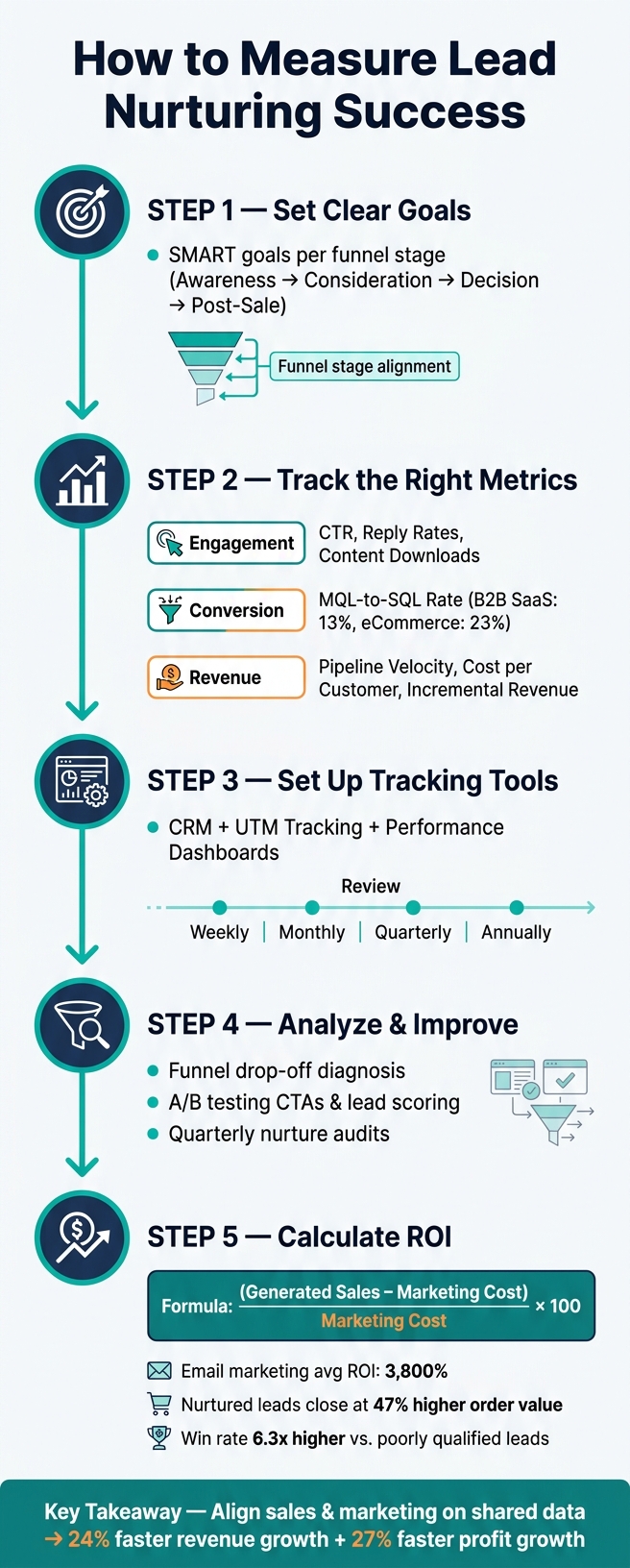
How to Measure Lead Nurturing Success: 5-Step Framework
Tangible Ways to Measure Lead Nurturing
sbb-itb-0a5855c
Step 1: Set Clear Goals for Your Lead Nurturing Campaign
Before you can measure success, you need to define what success looks like. Setting clear goals tied to your sales funnel is essential for understanding your campaign’s performance. Carly Miller from Madison Logic sums it up perfectly:
"If you’re not tracking the right key performance indicators (KPIs) at the right stages, you’re not nurturing – you’re just sending content into the void."
The key is to establish objectives that align with each stage of your funnel and adjust them as leads move closer to making a purchase.
Define Your Campaign Objectives
Each stage of the funnel requires a different focus. For example, someone who just discovered your brand won’t need the same approach as someone actively comparing solutions. Your goals should evolve as leads progress through the buying journey.
Here’s how objectives and metrics can vary by funnel stage:
- Awareness Stage: The focus is on visibility. Metrics like email open rates, website visits, and impressions help measure how well your brand is reaching new audiences.
- Consideration Stage: Engagement becomes the priority. Look at click-through rates (CTR), webinar registrations, and time spent on key product pages to gauge interest.
- Decision Stage: At this point, the goal is conversion. Success is measured by opportunities created, meetings booked, and the MQL-to-SQL (Marketing Qualified Lead to Sales Qualified Lead) conversion rate.
- Post-Sale Stage: After the sale, retention and expansion take the spotlight. Metrics like churn rate, upsell revenue, and customer satisfaction scores (NPS/CSAT) are critical.
| Funnel Stage | Primary Goal | Key Metrics |
|---|---|---|
| Awareness | Visibility & Recognition | Email Open Rates, Website Visits, Impressions |
| Consideration | Engagement & Intent | CTR, Webinar Registrations, Time on Pages |
| Decision | Pipeline & Conversion | Opportunities Created, MQL-to-SQL Rate, Meetings Booked |
| Post-Sale | Retention & Expansion | Churn Rate, Upsell Revenue, NPS/CSAT |
Establish Your Success Criteria
Once your objectives are clear, it’s time to define specific success criteria. This means setting measurable targets with realistic deadlines – vague goals like "improve engagement" won’t cut it.
Using the SMART framework (Specific, Measurable, Attainable, Relevant, Timely) is a great way to create actionable goals. For instance, instead of saying "increase email engagement", a SMART goal would be: "Increase email click-through rates by 15% within 90 days for leads in the consideration stage."
It’s also important to build a review process into your plan. For example:
- Monitor early engagement metrics like email opens and clicks on a weekly basis.
- Analyze content performance monthly to see what’s resonating.
- Evaluate the campaign’s impact on the pipeline quarterly to ensure long-term results.
Lastly, make sure marketing and sales teams are aligned on what "sales-ready" means. Misalignment between departments can derail even the best campaigns, so agreeing on a shared definition ensures that nurtured leads are genuinely ready to drive revenue.
Step 2: Pick the Right Metrics to Track
Once your goals are set, the next move is zeroing in on the metrics that actually matter. Not all numbers on your dashboard tell the full story – what’s important depends on where a lead is in the funnel and what you’re trying to uncover.
Engagement Metrics
Engagement metrics help you understand how leads are interacting with your content. Think of metrics like click-through rates (CTR), reply rates, and content downloads – these offer clear signals of interest. However, don’t put too much stock in email open rates. As the Prospeo Team points out:
"If your email dashboard still leads with open rate, stop. Apple Mail Privacy Protection turned it into a vanity metric."
With privacy updates skewing open rate data, it’s smarter to focus on metrics that reflect real engagement, like link clicks or downloads. Another critical metric is your unsubscribe rate. If it creeps above 1% for any audience segment, it’s a red flag that your content might not be hitting the mark.
Once you’ve gauged engagement, the next step is assessing how well you’re converting that interest into action.
Conversion Metrics
Conversion metrics are your guide to understanding how effectively you’re moving leads through the funnel. These metrics tie directly to your campaign goals and include transitions like lead to Marketing Qualified Lead (MQL) and MQL to Sales Qualified Lead (SQL).
One of the most telling indicators is the MQL-to-SQL conversion rate, which sheds light on how well marketing and sales are working together. For reference, industry benchmarks suggest average rates of 13% for B2B SaaS and 23% for eCommerce. If your rate is lagging, it might mean leads aren’t being nurtured enough before being passed to sales, or your lead scoring system might need fine-tuning.
| Industry | MQL-to-SQL Rate |
|---|---|
| B2B SaaS | 13% |
| eCommerce | 23% |
| Cybersecurity | 15% |
| Business Insurance | 26% |
| Fintech | 11% |
Source:
Another key metric to watch is time to customer conversion, which measures how long it takes a lead to move from initial contact to closing the deal. If this timeline drags on, it could point to bottlenecks in your funnel.
Revenue and Efficiency Metrics
These metrics bridge your nurturing efforts with tangible business results. As Corey Wainwright from HubSpot emphasizes:
"Your end goal as a marketer is not to generate leads, it’s to generate customers – and at the most efficient cost possible."
Two standout metrics here are cost per customer and pipeline velocity. Cost per customer shows how efficiently your campaigns are converting leads into paying customers – ideally, this number should drop as your nurturing strategies improve. Pipeline velocity, on the other hand, gives you a forward-looking view of revenue. The formula is:
(Opportunities × Average Deal Size × Win Rate) ÷ Sales Cycle Length.
If pipeline velocity is climbing, it’s a sign your efforts are working. But if it’s stuck in neutral, you may need to dig into what’s slowing things down.
Lastly, keep an eye on incremental revenue – the extra revenue generated from leads who went through your nurture sequence compared to those who didn’t. This metric can help you see the direct impact of your nurturing strategies on your bottom line.
Step 3: Set Up Tracking and Reporting Tools
Once you’ve identified the metrics that matter, the next step is making sure you’re consistently collecting accurate data. Without a reliable tracking system, you’re left guessing what’s working and what’s not.
Build Your Tracking Infrastructure
Start with a CRM that not only logs every interaction but also supports behavior-based automation. This ensures that every touchpoint is recorded, helping you identify patterns and trends. Pair your CRM with UTM parameters to tag URLs, which allows you to pinpoint the source of your leads. Combine this with conversion tracking on key landing pages, and you’ll gain a clear understanding of which touchpoints are driving leads through your funnel.
Don’t stop there – multi-channel tracking is essential. By capturing interactions across email, SMS, and phone, you ensure no lead slips through the cracks.
"Inbound marketers rely on data, not intuition." – Corey Wainwright, HubSpot
Once your tracking system is in place, consolidate the data into easy-to-read performance dashboards.
Build Simple Performance Dashboards
After your data starts flowing, organize it in a way that highlights actionable insights. Instead of lumping all metrics together, structure them by funnel stages: Awareness, Consideration, Decision, and Post-Sale. This approach makes it easier to identify bottlenecks. For instance, if engagement is high during the Consideration phase but MQL-to-SQL conversion rates are low, it could signal a disconnect between marketing and sales.
Establish a consistent review schedule to identify and address issues early:
| Review Frequency | Metrics to Focus On |
|---|---|
| Weekly | Email CTR, website traffic, ad engagement |
| Monthly | Content downloads, webinar attendance, time-on-page |
| Quarterly | Pipeline contribution, deal velocity, MQL-to-SQL conversion |
| Annually | Retention rate, upsell revenue, churn rate |
Source:
Regular reviews help you stay proactive. Carly Miller of Madison Logic emphasizes this point:
"Lead nurturing metrics aren’t just for reporting – they’re the blueprint for growth. When used correctly, KPIs tell you what’s working, what’s lagging, and where to double down."
Lastly, integrate sales and marketing dashboards to keep both teams aligned. This not only ensures clarity on what qualifies as "sales-ready" but also helps refine your lead scoring model based on behaviors that consistently lead to closed deals.
Step 4: Analyze Your Data and Improve Your Campaigns
Now that your dashboards are up and running, it’s time to dig into the numbers and turn them into actionable strategies. Data by itself doesn’t solve problems – it’s about identifying trends, diagnosing issues, and making informed decisions to refine your campaigns.
Diagnose Campaign Performance Issues
To figure out where things might be going wrong, start by tracking how leads move – or don’t move – through your sales funnel. A funnel report can highlight where potential customers drop off. For instance, if leads are engaging with content during the consideration stage but aren’t making it to the decision stage, it might point to a problem with your messaging or timing rather than a lack of traffic.
It’s also helpful to compare engagement metrics with pipeline data. If you’re seeing high engagement but no corresponding increase in opportunities at the decision stage, it could mean your content is sparking interest but isn’t pushing leads toward sales-readiness.
| Buying Stage | What Underperformance Signals | Where to Look |
|---|---|---|
| Awareness | Low brand recognition or weak subject lines | Open rates, website visits |
| Consideration | Content failing to build intent | CTR, time on product pages |
| Decision | Misaligned messaging with sales goals | MQL-to-SQL conversion rate |
| Post-Sale | Poor long-term value delivery | Churn rate, upsell revenue |
Run A/B Tests to Improve Results
If you notice a drop-off, don’t jump to conclusions – test your assumptions. Madison Logic offers a practical approach:
"If you see a drop-off between content engagement and opportunity creation, run A/B tests on calls to action (CTAs), lead scoring thresholds, or sales outreach timing."
Focus your tests on elements that directly impact your pipeline. While testing subject lines or send times can be useful, you’ll likely get more impactful results by experimenting with CTA button text, landing page layouts, or even the mix of channels you’re using. For example, does a multi-channel approach work better than relying on email alone?
Before testing, make sure your audience is properly segmented. Running tests on a mixed group can lead to skewed results because the content won’t align with where each lead is in their buying journey. Well-structured tests can provide the clarity you need to fine-tune your nurturing strategies.
Adjust Your Nurturing Strategy Based on Data
Use the insights from your tests and performance metrics to tweak your workflows. For example, if your email click-through rates are stagnating but webinar registrations are growing, consider shifting resources toward more interactive formats. At the same time, adjust your sequence strategies to reflect these changes.
When sales teams aren’t accepting MQLs, it’s often an issue with lead scoring. To fix this, schedule regular meetings between sales and marketing teams to review closed-won accounts and their engagement data. Use these insights to refine your scoring criteria and ensure alignment.
"Nurture programs should be treated like living systems – not static workflows." – Madison Logic
A great way to stay proactive is by conducting quarterly audits of your nurture sequences. Identify underperforming workflows, update outdated content, and experiment with shorter, more targeted sequences. Pair this with a shared dashboard for sales and marketing teams so everyone is aligned on what qualifies as "engaged" and which accounts to prioritize. This coordinated approach ensures your campaigns remain dynamic and effective.
Step 5: Calculate ROI and Measure Long-Term Impact
Once you’ve analyzed your campaign’s performance, the next step is to prove its overall impact. This is where you validate the success of your lead nurturing efforts and gather insights to refine future strategies. Essentially, it’s about showing the value your campaigns deliver.
Use Clear Formulas to Calculate ROI
The easiest way to calculate ROI is with this formula:
(Generated Sales – Marketing Cost) / Marketing Cost × 100
For example, a campaign delivering a 500% ROI far exceeds the 5:1 ratio often considered "very good" across most industries. Email marketing, which often serves as the backbone of nurturing campaigns, averages an impressive ROI of 3,800%.
"ROI is typically used to create long-term campaign goals and determines the success of a particular strategy." – Campaign Monitor
To ensure accuracy, track leads back to their original source and maintain consistent attribution throughout the customer journey. As Kimberly Marx from Big Bang advises:
"To keep things simple, make the lead source the FIRST conversion and do not change it, ever. Treat your retention activities as supporting acts to this original lead generation campaign."
It’s important to wait for a complete sales cycle to finish before finalizing ROI calculations. Jumping the gun can lead to an incomplete or misleading picture, especially in B2B markets where 40.4% of buyers may take 6 to 12 months to make a purchase decision.
Track Long-Term Gains Over Time
While ROI gives you a snapshot of past performance, long-term metrics help you predict future growth. Nurtured leads tend to close deals with a 47% higher order value and achieve a win rate that’s 6.3 times higher than poorly qualified leads.
Keep an eye on how these key metrics evolve over time:
| Metric | What It Tells You |
|---|---|
| Cost per Customer | Should decrease as nurturing efforts become more efficient |
| Sales Cycle Length | Should shorten as prospects are better informed |
| Customer Lifetime Value (CLV) | Should increase as nurtured customers buy more and stay longer |
| Lead Velocity Rate (LVR) | Tracks month-over-month growth in qualified leads, predicting revenue 60–90 days ahead |
To stay on top of trends, review metrics on a consistent schedule. Monitor click-through and reply rates weekly, evaluate mid-funnel progression and LVR monthly, and assess pipeline velocity and lead scoring adjustments quarterly. Annually, take a broader look at retention, CLV, expansion revenue, and NPS. This structured approach helps you not only address issues but also identify opportunities before they pass you by.
Conclusion: Key Steps to Measuring Lead Nurturing Success
Achieving success in lead nurturing hinges on five essential practices: setting clear goals, choosing meaningful metrics, establishing reliable tracking systems, regularly analyzing data, and calculating ROI across the full sales cycle. Skipping any of these steps can weaken the foundation of your data-driven approach.
As Corey Wainwright from HubSpot wisely states:
"Successful inbound marketers don’t make decisions based on feelings — their decisions are based on data."
This underscores the importance of relying on metrics that have a direct impact on revenue. While metrics like open rates may look impressive, they often fail to provide actionable insights. Instead, focus on indicators that genuinely predict revenue, such as click-through rates, MQL-to-SQL conversion rates, Pipeline Velocity, and Customer Lifetime Value.
Consistency is what separates top-performing teams from the rest. Regular reviews – like weekly CTR and reply rate evaluations, monthly mid-funnel performance checks, and quarterly lead scoring adjustments – ensure your strategy stays on track. Aligning sales and marketing efforts around shared data can lead to 24% faster revenue growth and 27% faster profit growth.
For businesses looking to implement a results-focused lead nurturing strategy, Green Forest Marketing offers proven outreach, email marketing, and follow-up frameworks designed to drive revenue growth effectively.
FAQs
Which lead nurturing metrics matter most for my funnel stage?
The metrics you should focus on depend heavily on where your leads are in the sales funnel. At the earlier stages, it’s all about tracking engagement. This could mean keeping an eye on how often people are consuming your content or how frequently they interact with it – both are strong indicators of initial interest.
As leads move further down the funnel, the focus shifts. Now, it’s time to prioritize metrics that reflect intent, like conversion rates, demo requests, or other actions that show they’re getting closer to making a purchase.
By consistently monitoring engagement, content interactions, and how leads progress through the funnel, you can get a clear picture of what’s working and measure success at every stage.
How do I track lead nurturing across channels without messy attribution?
To make tracking lead nurturing across channels easier, prioritize engagement metrics and progression signals over complicated attribution models. Focus on metrics like response rates, open rates, click-through rates, and how much content your audience is consuming. At the same time, keep an eye on progression signals such as increased interactions, re-engagement of inactive leads, and behavioral patterns. This method emphasizes valuable interactions and tracks how leads move through the funnel, sidestepping the challenges of channel-specific attribution.
What’s the simplest way to prove lead nurturing ROI in dollars?
To show the dollar value of lead nurturing ROI, compare the revenue generated from nurtured leads versus non-nurtured leads. Typically, nurtured leads lead to higher-value deals, directly impacting revenue. You can also calculate ROI by weighing the revenue from nurtured leads against the costs of your campaigns. This approach links your nurturing efforts to clear financial results.

