
GEO vs SEO
If I had to sum it up in one line: SEO helps me win clicks from Google; GEO helps me get named in AI answers.
Today, I can’t treat search and AI as the same channel. A person might search “plumber near me” on Google, or ask ChatGPT the same question and never visit a results page at all. That changes how I write, structure, and measure content.
Here’s the short version:
- SEO is about ranking in Google and Bing
- GEO is about getting cited in ChatGPT, Google AI Overviews, and Perplexity
- SEO usually drives direct visits and local leads
- GEO often helps earlier in the buying process
- Both depend on a fast site, clear business details, and pages that answer questions directly
- Studies cited in the article point to about a 40% lift in AI visibility for content shaped for GEO
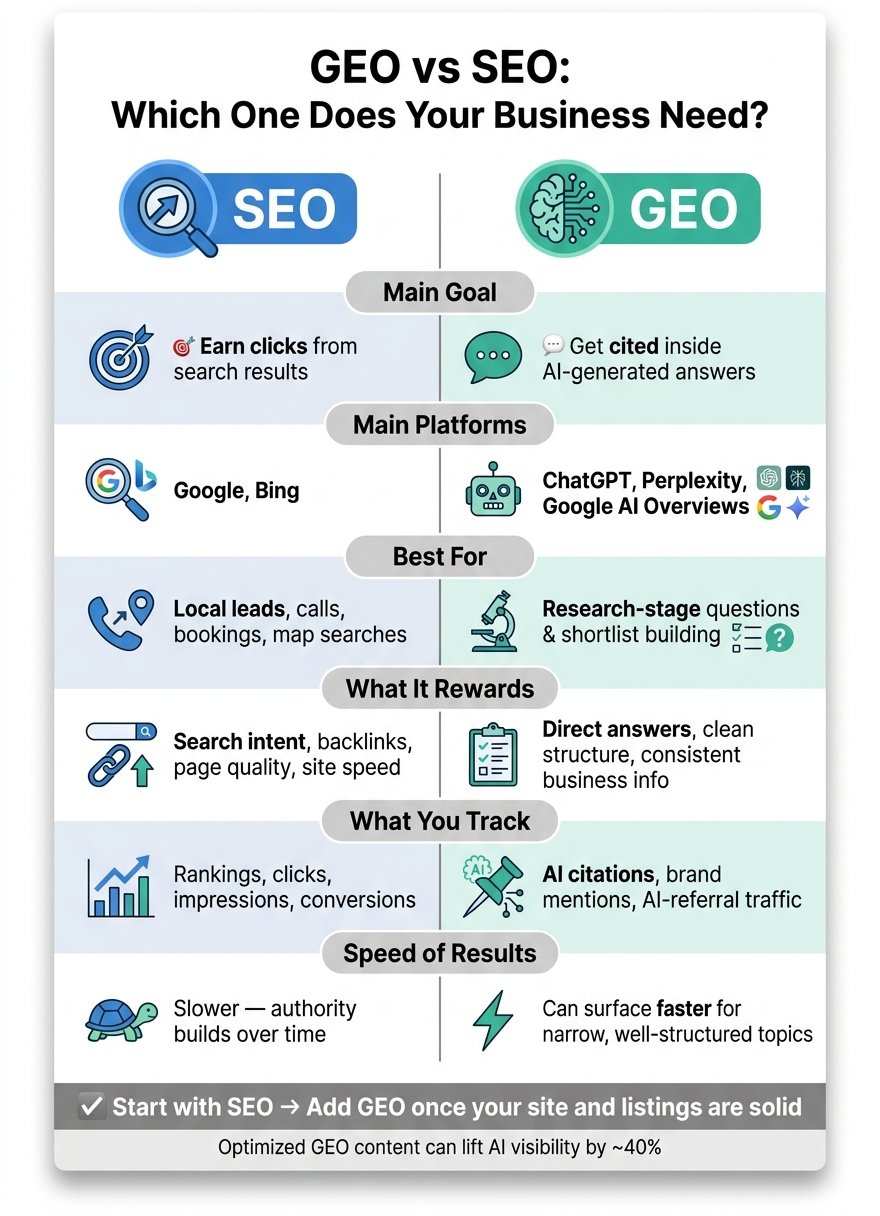
GEO vs SEO: Side-by-Side Comparison for Small Businesses
SEO vs GEO: Key Differences & Ranking Strategies For 2026
sbb-itb-0a5855c
Quick Comparison
| Criteria | SEO | GEO |
|---|---|---|
| Main goal | Earn clicks from search results | Get mentioned in AI-generated answers |
| Main platforms | Google, Bing | ChatGPT, Perplexity, Google AI Overviews |
| Best for | Local leads, calls, bookings, map searches | Research-stage questions and shortlist building |
| What it rewards | Search intent, page quality, backlinks, site performance | Direct answers, clean structure, consistent business info, source-ready content |
| What I track | Rankings, clicks, impressions, conversions | AI citations, brand mentions, AI-referral visits, branded search growth |
| Time to see movement | Often slower | Can appear sooner for narrow topics if content is easy to parse |
Bottom line: if I run a small U.S. business, I’d start with SEO, then add GEO once my site, local listings, and page structure are in good shape. That’s the simplest way to cover both search traffic and AI-driven discovery.
What SEO Is and How It Works
Search Engine Optimization (SEO) helps your site show up higher in Google and Bing for searches that can bring in traffic, leads, and sales.
SEO goals, channels, and core ranking signals
For local businesses, SEO is about showing up when people are ready to act. The aim is simple: rank for searches that lead to calls, form fills, and in-person visits.
Search engines look at relevance, authority, and technical quality. Modern SEO is less about stuffing in keywords and more about matching what the searcher wants. If someone types in "how much does a roof repair cost", they want a straight answer, not a hard sell. That’s where many sites miss the mark.
Page speed matters too. Slow pages can hurt both visibility and conversions. Backlinks from reputable websites help show authority, and trusted directory listings, along with more branded searches for your business, can help local discovery.
Google also looks for signs that a business is real and trustworthy. In plain English, that can mean original photos, clear author details, and proof of completed work.
But none of that means much if you can’t track it.
SEO tools and metrics that show business value
Google Search Console shows which search queries bring people to your site, how many impressions and clicks you get, and whether your Core Web Vitals are in good shape. Google Analytics 4 (GA4) connects that traffic to business outcomes like conversions and form completions. Ahrefs is another SEO tool you can use to watch visibility over time.
Traffic numbers can look good on paper and still lead nowhere. What matters is whether organic traffic turns into leads. That’s why it makes more sense to track conversions, not just visits. For a local business, conversion rate tells you more than raw traffic ever will.
These same quality signals matter later when AI systems decide what to quote or cite.
What GEO Is and How It Works
Generative Engine Optimization (GEO) helps AI systems find, check, and cite your content in generated answers. SEO tries to win clicks from search results. GEO tries to get your business mentioned inside the answer itself. That shift makes structure and clarity matter more than keyword stuffing.
For local businesses, this matters when people ask an AI who to hire, where to go, or which provider they should trust.
GEO works because AI systems pull live sources when answering a query. In plain English: short, focused passages that give a direct answer tend to do best.
Where GEO shows up and what AI systems look for
GEO shows up in AI answers people use when they research services and purchases. Each platform cites sources a bit differently:
| AI Surface | Citation Behavior |
|---|---|
| Google AI Overviews | Links appear in a "sources" panel; favors high-authority domains |
| ChatGPT Search | Inline footnotes; respects the OAI-SearchBot crawler |
| Perplexity | Numbered citations attached to every factual claim |
For small businesses, these are now key places where buyers build a shortlist before they call.
AI systems tend to favor:
- Direct answers
- Clear section headers
- Consistent business name, address, and profile details across trusted sources
- Original photos and case studies that show real experience
GEO metrics and signs it is working
You’ll usually know GEO is working when your brand starts showing up in AI citations, branded search goes up, and AI-referred visitors turn into leads. Benchmark studies also show that optimized content can lift visibility in AI responses by about 40%. For a small business focused on local lead generation, that can make a big difference.
Next, compare GEO and SEO by how people search, what each channel rewards, and when each one tends to drive better results.
GEO vs SEO: Side-by-Side Comparison
Here’s a direct look at how the two approaches stack up across the areas that matter most to a small business owner. The gap becomes a lot easier to see when you look at how each channel rewards content.
| Feature | Traditional SEO | GEO |
|---|---|---|
| Primary Goal | Rank on Search Engine Results Pages (SERPs) and earn clicks | Get cited inside an AI-generated answer |
| Main Channels | Google, Bing | ChatGPT, Perplexity, Google AI Overviews |
| Content Focus | Keywords, backlinks, meta tags | Structured data, clear facts, concise direct answers |
| Key Tools | Google Search Console, Ahrefs, Semrush | Profound, Peec AI, AI bot log analysis |
| Speed of Results | Slow – authority builds over time | Can surface faster for specific queries when content is clear and crawlable |
| Measurable Outcomes | Clicks, impressions, organic traffic | AI citations, AI-referral traffic, brand mentions |
These differences stand out even more in the way people search and make decisions.
How user behavior differs across search engines and AI answers
When someone uses Google, they usually scan a page of links and pick the one that looks best. With AI tools, people tend to ask full questions and read a single stitched-together answer. That changes the game.
A lot of informational searches now end inside the AI response, without a click at all. So the goal shifts. In SEO, you want the visit. In GEO, you want the mention.
SEO tends to reward pages that line up with keyword intent and pick up backlinks. GEO tends to reward short, self-contained passages that an AI system can quote directly.
When one channel outperforms the other
SEO still does better for transactional searches and local lead generation – when someone is ready to book, buy, or call.
GEO has more pull earlier in the research phase. When buyers are weighing options or asking broad questions before they’re ready to commit, AI tools are more often where that research starts. A service business that lays out its content clearly – covering common questions, pricing ranges, and process steps – gives AI systems something concrete to cite when a potential customer is building a shortlist.
Both still depend on a fast, crawlable site. The next step is figuring out which channel should take the lead in your plan.
When to Use SEO, GEO, or Both
After looking at how SEO and GEO work, the next step is deciding where to put your time first.
Start with SEO if you need stronger search rankings and local leads
If your business relies on local search, phone calls, and map visibility, start with SEO. Clean up the basics first. Make sure your NAP data stays consistent, add Schema.org markup, and fix site issues that make it hard for search engines to read your pages. That helps both search engines and AI systems verify who you are and what you offer.
Think of SEO as the base layer. If that part is shaky, everything built on top of it gets harder.
Once that base is in place, GEO can help your business show up in AI-generated answers too.
Add GEO when buyers use AI to research before buying
GEO makes more sense when people spend time researching before they reach out. That usually happens with higher-cost purchases, longer sales cycles, and searches tied to learning rather than immediate action.
One clear sign? Your traffic stays flat even when rankings don’t move much. That can mean AI summaries are answering your top informational queries before people ever click through to the usual blue links.
If you want AI systems to mention your brand, make it easy for them. Put a short, direct answer near the top of the page. Then support it with clear JSON-LD schema that matches the page content.
Conclusion: The simplest way to think about GEO vs SEO
The easiest way to frame it is this: SEO earns clicks. GEO earns citations. Most small businesses should begin with SEO, then add GEO after the site is in good shape and buyers start doing research inside AI tools.
FAQs
Can GEO replace SEO?
No. GEO does not replace SEO. It builds on what you already do.
SEO still matters for standard search visibility, especially when you want to show up for transactional or local searches. GEO helps your business appear in AI-driven search results and answer engines.
For small businesses, the best move is to use both.
How do I measure GEO results?
Measure GEO by paying less attention to clicks and impressions and more attention to how often your brand shows up in AI-generated answers. In many cases, success means your domain gets cited in AI summaries even when people never land on your site.
A few things are worth watching:
- AI referral traffic in GA4
- Share of voice with tools like Profound, Peec AI, Otterly, or AthenaHQ
- Server logs to see whether AI bots are crawling your site
- Schema and brand details to make sure they stay consistent across the web
That shift matters. With GEO, visibility can matter just as much as traffic. If an AI assistant mentions your site as a source, that still puts your brand in front of the user – even if there’s no click attached to it.
What should I optimize first?
Start with a solid technical base. Make sure your site is accessible and machine-readable by checking that robots.txt and server settings aren’t blocking AI crawlers like GPTBot and ClaudeBot.
Then add JSON-LD schema markup so AI can verify your business identity and credentials. After that, shift to content tactics like the 60-word answer-first model.
