
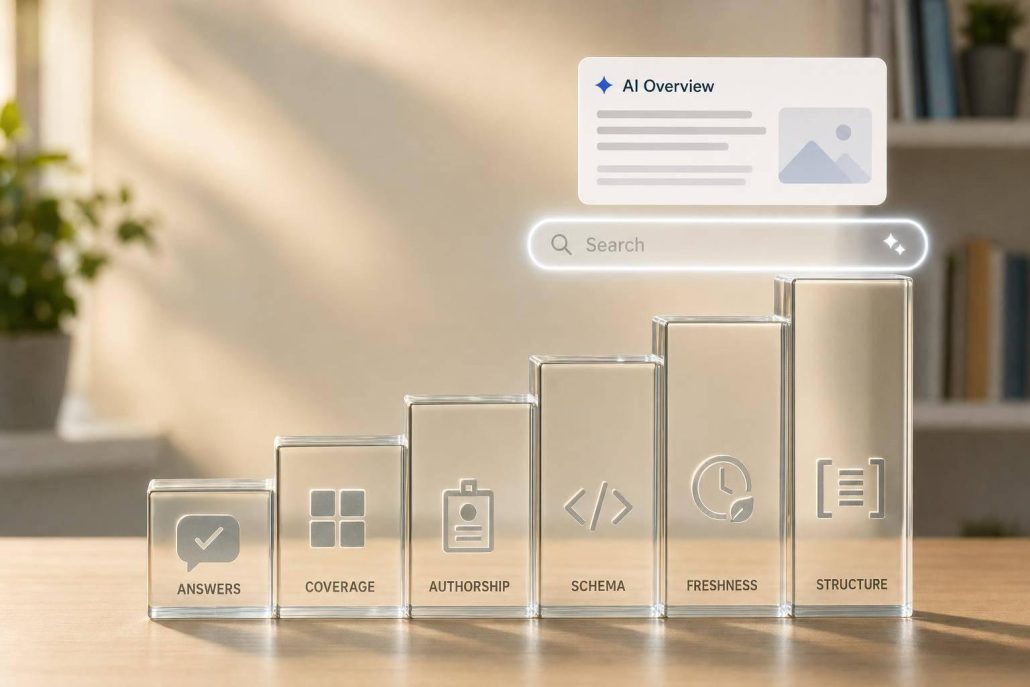
AI Overview ranking factors
If you want Google to cite your page in an AI Overview, start with three things: answer the query fast, cover the topic well, and show clear proof of who wrote it.
As of February 2026, AI Overviews show on about 48% of informational searches in the U.S. They often pull from 3 to 8 sources, not just one. That means I’d focus less on “ranking #1” alone and more on making pages easy for Google to quote.
Here’s the short version:
- Go after informational searches first like how, what, why, and comparison terms
- Open key sections with a direct answer in about 40–80 words
- Cover related questions, not just the main keyword
- Show who wrote the page and who the business is
- Use schema like
Article,FAQPage,Person, andOrganization - Update pages often, since newer updates tend to get cited more
- Check pages ranking positions 3–10 in Google Search Console for low CTR gaps
- Make sure
Google-Extendedisn’t blocked inrobots.txt
A few numbers stand out:
- Pages with strong topic coverage are 4.2x more likely to get cited
- Ranking for a related query can lift citation odds by 161%
- Updated pages can earn 28% more citations
- Brands cited in AI Overviews can get 35% more organic clicks
If I were turning this into a plan, I’d fix content structure first, then authorship and schema, then brand mentions and topic clusters. That’s the shortest path to more AI Overview visibility for a small business.
Have Google’s AI Overview Ranking Factors Been Revealed?
sbb-itb-0a5855c
How Google selects sources for AI Overviews
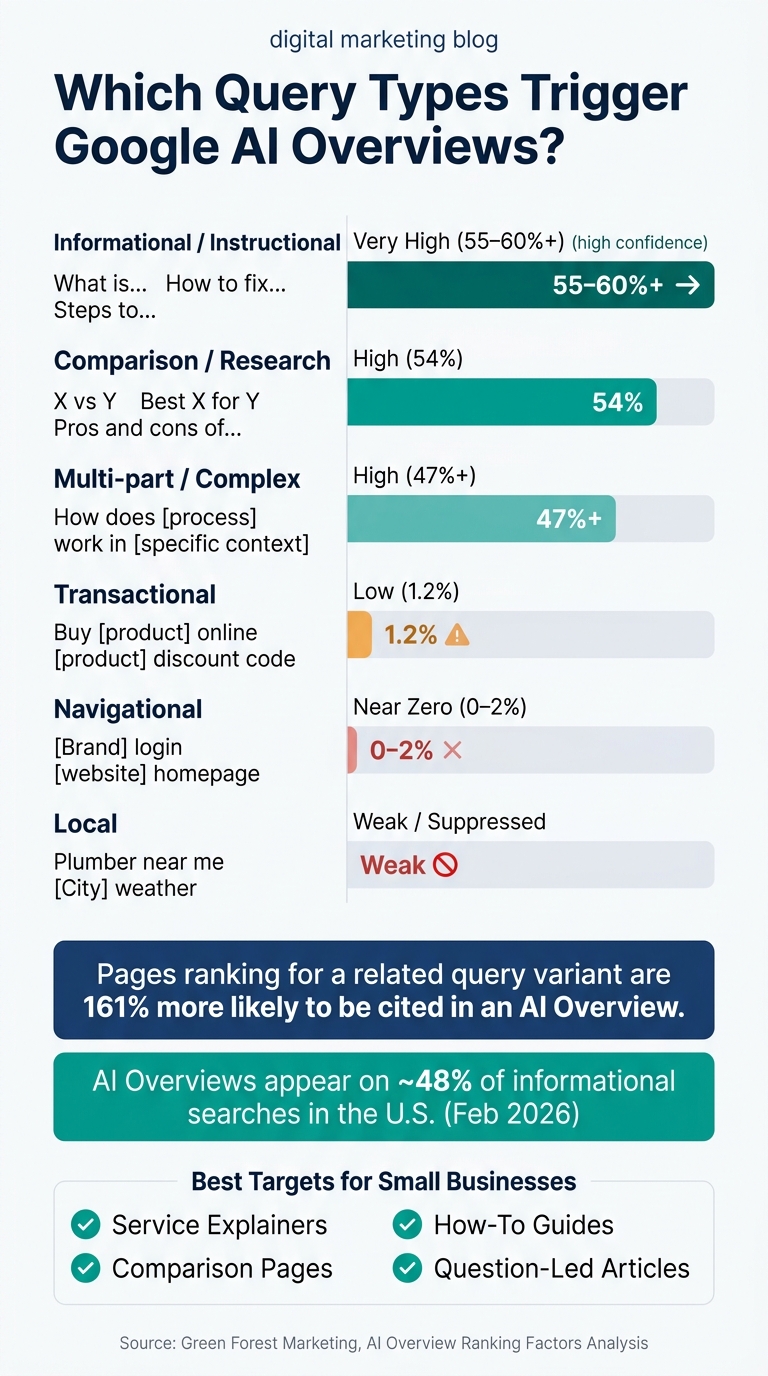
AI Overview Ranking Factors: Query Intent vs. Citation Likelihood
Google tends to show AI Overviews for informational searches. Then it cites pages that answer the question in a clear, trustworthy way. Once Google decides a query should get a summary, the next job is simple: pick pages it feels safe citing.
Query types most likely to trigger AI Overviews
AI Overviews appear most often for informational searches. That makes informational, how-to, and comparison queries the strongest targets. Transactional and navigational queries, on the other hand, usually don’t get much traction.
| Query Intent Type | AI Overview Likelihood | Example Query Patterns |
|---|---|---|
| Informational / Instructional | Very High (55–60%+) | "What is…", "Why does…", "How to fix…", "Steps to…" |
| Comparison / Research | High (54%) | "X vs Y", "Best X for Y", "Pros and cons of…" |
| Multi-part / Complex | High (47%+) | "How does [process] work in [specific context]" |
| Transactional | Low (1.2%) | "Buy [product] online", "[product] discount code" |
| Navigational | Near Zero (0–2%) | "[Brand] login", "[website] homepage" |
| Local | Weak / Suppressed | "Plumber near me", "[City] weather" |
For small businesses, the takeaway is pretty clear. The best shot at showing up in AI Overviews comes from pages built to answer customer questions head-on, like:
- service explainers
- comparison pages
- how-to guides
- question-led articles
What makes a page easy for AI systems to read and cite
Google expands a query into related searches, then pulls from pages that give a direct, complete answer in one section. If your page ranks for at least one of those related search variants, your chance of being cited goes up by 161%.
That’s a big jump. And it helps explain why broad topic coverage inside one page, or across a tightly linked cluster, matters so much. You don’t want to answer just the main question. You want to answer the nearby questions too.
The pages that tend to get cited make life easy for Google. They use direct answers, clear headings, and structured data so the right passage can be found fast. A good rule of thumb is to open each main section with a 40–80 word direct answer, then add the extra detail underneath. Question-style headings also help, like "How much does X cost for a small business?" Structured data such as FAQPage or HowTo schema gives Google more context as well.
Brand mentions across the web can also strengthen trust in the source.
So if you’re picking pages to work on first, go for the ones that answer high-intent questions clearly and fully. Those are usually the pages with the best shot at earning citations.
The main ranking factors small businesses can control
Relevance, intent match, and full topic coverage
Once Google decides a query should trigger an AI Overview, the next question is simple: which pages deserve a citation?
A big part of that comes down to topic coverage, not just keyword use. Pages with high coverage are 4.2x more likely to be cited. So it’s not enough to answer the main question and move on. You need to cover the nearby questions too: edge cases, follow-ups, and the little “okay, but what about this?” concerns people have before they take action.
For service pages and lead-gen pages, this matters a lot. If you want citations, your page should feel complete. That means answering the main query, then backing it up with the context a customer would want before calling, booking, or filling out a form.
A simple way to do this:
- Build a pillar page around the main topic
- Add supporting articles for related questions
- Combine thin posts into one stronger page
Coverage gets your page into contention. Trust is what helps Google pick it.
Authority, accuracy, trust, and brand signals
Google has expanded its E-E-A-T standards across all content categories, not only health or finance. And the pattern is hard to ignore: 96% of AI Overview citations come from sources with clear author and business credibility signals.
That has a very practical meaning for small businesses. Anonymous content or ghostwritten pages can work against you. Google wants to see who wrote the content, why that person should be believed, and what business stands behind the site. Named authors, real credentials, linked author pages, linked organization profiles, and a clear editorial process all help.
Brand mentions and reviews matter too. They help confirm that the business exists, serves real people, and has a reputation beyond its own website.
After relevance and trust, Google still has one more hurdle: can it pull the answer from your page fast?
Structure, freshness, and technical quality
AI systems tend to favor pages that are easy to scan and easy to extract from. Clear headings, short paragraphs, and direct answer paragraphs near the top of each section make a big difference. Google wants a page it can use in seconds, not one it has to decode.
A good target is a 40–60 word direct answer right under each H2, followed by supporting detail. Think of it like giving Google the short version first, then the proof right after.
Schema helps too. Using Article, FAQPage, Person, and Organization JSON-LD together can lead to 2x more citations than using just one schema type.
Freshness also plays a part. Pages updated within the last two months earn 28% more citations than older pages. That’s why a quarterly review makes sense. Refresh stats, swap in current examples, and update the modified date in your schema.
One more technical check matters here: make sure your robots.txt file allows Google-Extended. If it’s blocked, your pages may be less likely to earn citations.
How to turn ranking factors into an action plan
Finding AI Overview opportunities on your website
Start with pages that are already close to page one.
Open Google Search Console and look for queries where your average position is between 3 and 10, but the click-through rate is lower than you’d expect. That gap can point to an AI Overview taking attention before people click your result. Those pages should move to the top of your list.
Next, check your top informational queries in a private browser window. If an AI Overview shows up and your page isn’t cited – even though it ranks in the top 10 – that page is a top target for updates. Pages outside the top 10 almost never get the AI Overview citation for that query. Put extra focus on "how", "what", and "why" searches tied to your services and location.
Matching page types to the right optimization priorities
Once you’ve found the openings, match each page to the fix that makes sense for its role.
| Page Type | Primary AI Overview Priority | Key Optimization Focus |
|---|---|---|
| Service Pages | Intent Match & Trust | Add "how it works" and pricing sections; use Service and Organization schema |
| Local Landing Pages | Local intent | Answer location-specific customer questions; move beyond "City + Service" templates |
| Blog Posts & Guides | Depth & Freshness | Lead with a 40–70 word direct answer under each H2; update about every 90 days |
| FAQ Resources | Answer clarity | Use FAQPage schema; keep each answer to 40–60 words with no preamble |
Here’s the part many teams miss: a page with the better snippet-style answer can get cited over a denser page that ranks a bit higher.
How Green Forest Marketing supports AI Overview readiness
Turning this into action usually means work across technical SEO, content structure, and off-site authority. Green Forest Marketing can help with technical SEO, structured content, schema, freshness, and authority signals that make pages easier for Google to cite.
Conclusion: Which ranking factors to focus on first
Now that the ranking factors are clear, the next move is simple: decide what to fix first.
AI Overview visibility usually doesn’t come from one big update. It comes from a string of focused improvements made over time. The main signals worth tackling first are intent alignment, topical authority, accuracy, trust, formatting, freshness, and technical quality.
Start with content targeting. Put your attention on pages that answer the main query in the first paragraph.
Then tighten trust signals. Make authorship easy to see, check that facts are correct, and clean up your schema.
Once content and structure are in better shape, move to authority-building. Work on brand mentions, topic clusters, and original data if you want visibility that lasts. Brand mentions are a stronger visibility signal than backlinks.
- Fix first: Lead each H2 with a direct answer and rewrite weak opening paragraphs
- Fix next: Add visible authorship, accurate facts, and clean schema
- Fix long-term: Earn brand mentions, build topic clusters, and publish original data
The goal stays the same across every fix: build pages that answer clearly, show trust, and stay easy to cite. For small businesses, these priorities offer the fastest path to AI Overview citations.
FAQs
How long does it take to earn AI Overview citations?
There’s no fixed timeline here. AI Overview visibility depends on whether the system pulls your content for certain informational searches or sub-queries, not whether you sit in a set ranking spot.
In most cases, it builds over time. Pages tend to show up more when they show strong topical authority, semantic completeness, and entity density. Regular organic rankings still matter, of course. But plenty of citations come from pages that aren’t even in the top 10.
That’s why steady updates can help. When your content stays current and gives clear, easy-to-pull answers, it has a better shot at staying in the mix.
Can a page rank well but still miss AI Overviews?
Yes. A page can rank well in organic search and still not show up in AI Overviews.
Good rankings help people find your page and can signal trust. But AI Overviews tend to pull from content that gives a clear, quote-ready answer.
If your answer is buried under marketing copy, hard to scan, or missing the exact facts the system needs, your page can get passed over for one that’s simpler to extract from and check.
What should I update first on an existing page?
Start with a passage-first intro under each H2. In plain terms, rewrite the first paragraph so it gives a direct answer to the heading in fewer than 40 words. It should stand on its own and skip promo language.
Then add FAQPage schema with five to eight questions and answers. That makes the page easier for AI systems to pull, quote, and summarize.

