
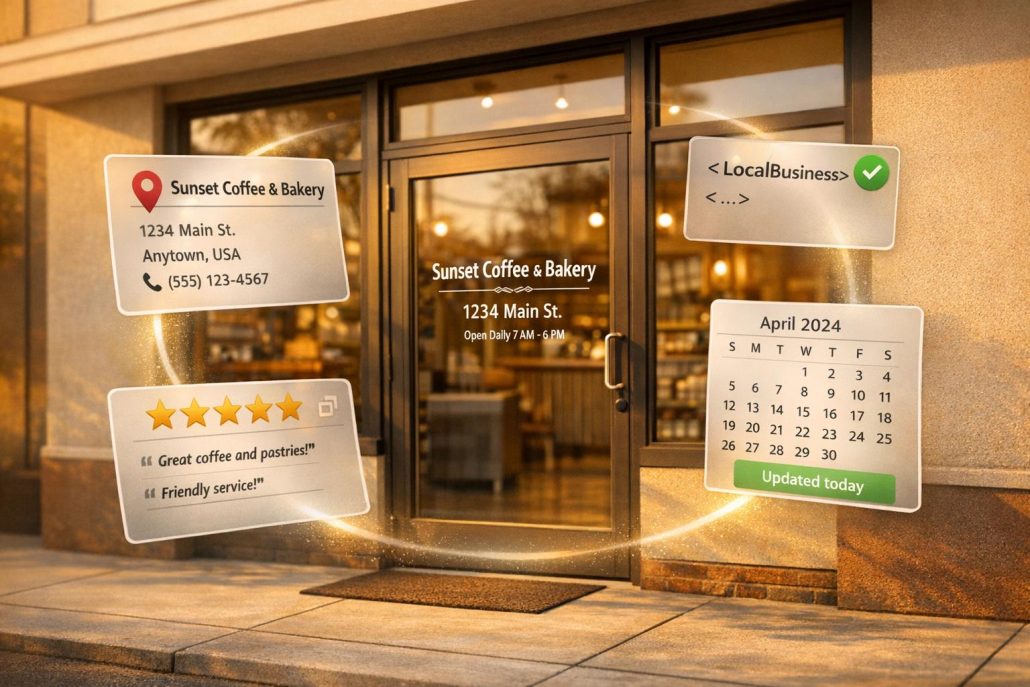
How ChatGPT finds businesses
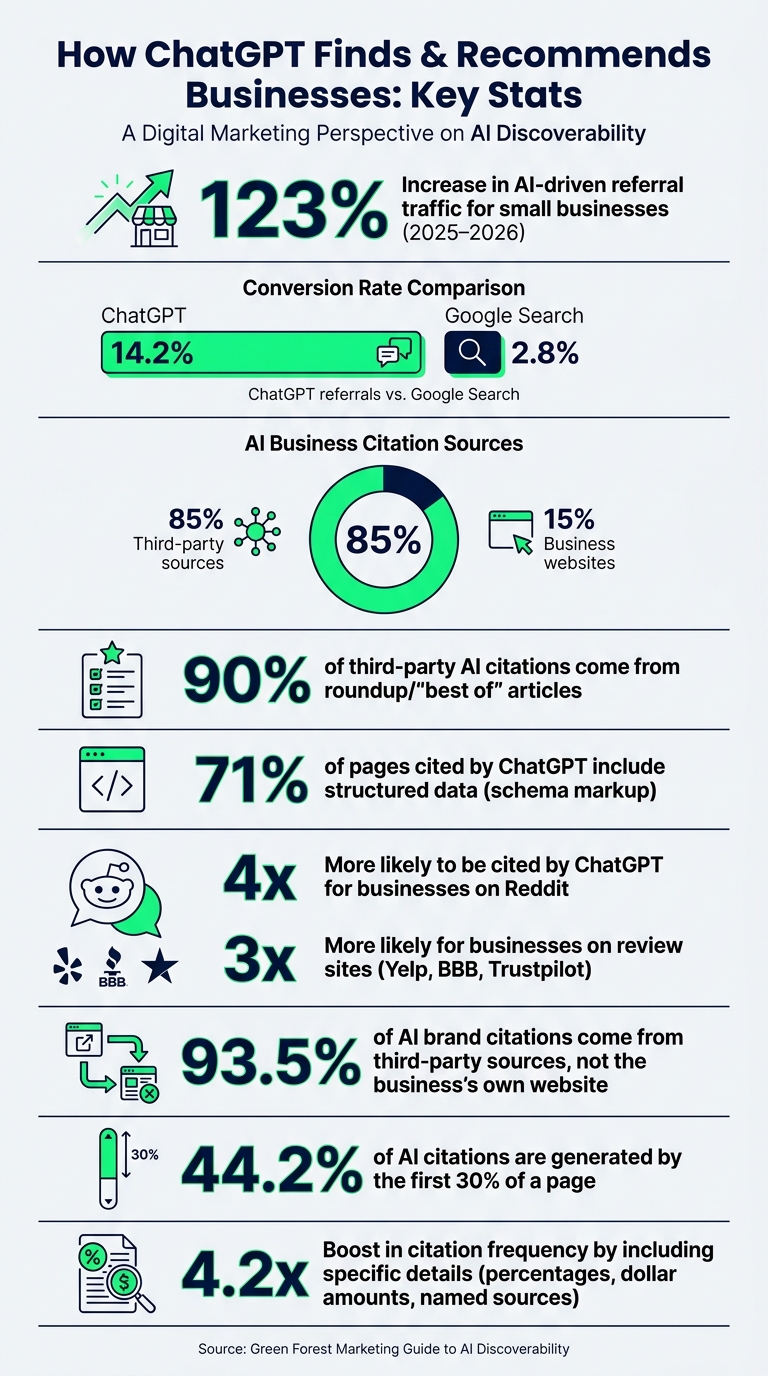
ChatGPT, powered by OpenAI, now helps users discover businesses by combining its extensive training data with real-time browsing via Bing. Unlike traditional search engines, it filters options and provides one or two recommendations, often with explanations. This shift has led to a 123% increase in AI-driven referral traffic for small businesses between 2025 and 2026, with conversion rates of 14.2%, far exceeding Google search’s 2.8%.
To get your business noticed by ChatGPT, focus on these steps:
- Consistent Information: Ensure your name, address, and phone number (NAP) match across platforms like Yelp, Google, and Facebook.
- Website Optimization: Allow AI bots to access your site, use clear service descriptions, and include a
llms.txtfile summarizing your business. - Schema Markup: Use JSON-LD schema types like LocalBusiness and FAQPage to help AI understand your site.
- Content Strategy: Write concise, direct answers to customer questions, use question-based headings, and keep content up-to-date.
- Leverage Reviews: Encourage detailed reviews on platforms like Yelp and Trustpilot to boost credibility.
These strategies can improve how AI systems like ChatGPT recognize and recommend your business. For more advanced help, consider working with specialists like Green Forest Marketing.
How ChatGPT Finds & Recommends Businesses: Key Stats
How ChatGPT Finds and Identifies Businesses
Key Data Sources ChatGPT Uses
ChatGPT pulls business information from a combination of static training data and real-time browsing through Bing. According to research, only 15% of AI business citations come directly from business websites, while a whopping 85% come from third-party sources. One of the most influential sources is Yelp, thanks to ChatGPT’s direct integration with it. This allows the AI to access real-time review scores and business details. Other platforms like Google, Bing, Facebook, the Better Business Bureau, Hotfrog, MerchantCircle, and Superpages also play a significant role in shaping the data ChatGPT uses.
Interestingly, 90% of third-party AI citations come from roundup articles and "best of" lists. This means being featured in articles like "Top 10 Restaurants in New York" or "Best Electricians in Los Angeles" can have a bigger impact on AI visibility than many business owners might expect.
"The businesses that dominate AI recommendations are the ones with strong signals across all these sources. The AI isn’t looking at any single platform. It’s synthesizing everything." – Dylan Allen-Arnegård, CEO & Co-Founder, Cheers
Why Consistent Business Information Matters
When ChatGPT encounters your business name, address, and phone number (NAP) across various platforms, it pieces together a unified profile of your business. However, inconsistencies – such as different address formats on Yelp and your website – can disrupt this process. These mismatches confuse the AI, leading to skipped listings or incorrect details being presented.
"Inconsistency breeds confusion – and AI skips confusion." – Lesli Rose, AI Discoverability Expert
Think of it like a background check. If your information doesn’t align across sources, it undermines trust. Maintaining consistent NAP data across at least 10 directories is a strong indicator of legitimacy and reliability.
How ChatGPT Evaluates Business Credibility
ChatGPT uses Named Entity Recognition (NER) to treat your business as a unique entity and cross-checks its details against other sources. The more consistent and corroborated the information across independent platforms, the higher the AI’s confidence in your business. For example, a claim on your website carries less weight than a mention in a local news article, an industry-specific directory, or even a Reddit thread. In fact, businesses with an active presence on platforms like Reddit are 4x more likely to be cited by ChatGPT. Similarly, having profiles on review sites such as Yelp, the Better Business Bureau, or Trustpilot makes businesses 3x more likely to be referenced.
Detailed reviews across multiple platforms not only enhance your reputation but also increase the likelihood of your business being recommended by ChatGPT. In the next section, we’ll dive into actionable steps to improve your business’s discoverability through AI.
sbb-itb-0a5855c
Steps to Make Your Business Discoverable by ChatGPT
Build a Website That Search Tools Can Read
If you want ChatGPT to recommend your business, your website must be accessible to AI crawlers. Surprisingly, many small business websites unintentionally block these crawlers through their robots.txt file. To avoid this, explicitly allow AI bots like GPTBot, ChatGPT-User, ClaudeBot, PerplexityBot, and Google-Extended to access your site.
But access alone isn’t enough – your site’s structure plays a key role. AI systems don’t browse websites like humans; instead, they extract facts. This means your service pages should include clear, direct descriptions of what you offer and where you operate. Start each section with a concise summary (40–60 words) to make it easier for AI to pull accurate data. As Tyler Hicks of Snakebite Consulting explains:
"Most businesses are invisible in AI search because their digital presence was built for human readers clicking links – not for AI systems extracting and citing answers."
A new best practice is to create a plain text file at yourdomain.com/llms.txt. This file serves as a Markdown-formatted cheat sheet for large language models, providing a clear and concise summary of your business.
Once your website is optimized, the next step is to ensure your business profiles are complete and up-to-date.
Set Up and Maintain Your Business Profiles
To improve your chances of being recommended by ChatGPT, your business profiles on major platforms must be accurate and consistent. Incomplete or mismatched information can make your business harder for AI systems to recognize.
Focus on key platforms like Google Business Profile, Bing Places, Apple Maps, Yelp, and LinkedIn. Fill out every available field, including your business description, services, hours, attributes, and opening date. Complete profiles signal trustworthiness to AI systems. Additionally, use the Q&A sections of these platforms to answer common customer questions with clear, factual responses. For Google Business Profile, aim to publish at least one Google Post each week. To ensure updates are processed quickly, submit your sitemap to Bing Webmaster Tools using the IndexNow protocol.
For businesses in specialized industries, don’t overlook niche directories. Platforms like Clutch (for B2B services), Avvo (for legal professionals), or HomeAdvisor (for trades) can enhance your credibility with AI-driven recommendation systems.
Lastly, structured data on your website can significantly boost discoverability.
Add Schema Markup to Your Website
Schema markup helps ChatGPT understand your website by converting its content into a format AI can reliably interpret. In fact, 71% of pages cited by ChatGPT include structured data.
The preferred format is JSON-LD, which is easier for crawlers to process since it’s separate from your HTML. For most small businesses, five schema types are essential: Organization, LocalBusiness, FAQPage, Article, and Service. When using the LocalBusiness schema, include precise geo-coordinates (to at least four decimal places) and leverage the sameAs property to link to your Google Business Profile, LinkedIn, and other directories. This cross-referencing helps build a stronger knowledge graph and boosts AI confidence in your business.
"If you’ve got two hours a week for marketing, spending 30 minutes on schema will outperform 30 social posts." – Clint Sanchez, Founder, BlakSheep Creative
Once you’ve implemented schema markup, validate it using the Google Rich Results Test and the Schema.org Validator. Keep in mind, even small syntax errors – like a missing bracket – can render the entire block unusable.
How to Get Your Local Business To Show Up In ChatGPT (Live Training)
Content Strategies to Improve Your Visibility for ChatGPT
Once you’ve optimized your website and profiles, the next step is ensuring your content aligns with how AI systems extract and process information. Focus on creating content that provides clear, direct answers. When paired with optimized technical profiles, these strategies can enhance your business’s credibility with AI platforms.
Write Content That Answers Customer Questions
Unlike traditional search engines, ChatGPT extracts information directly rather than browsing through multiple sources. This means your content needs to deliver answers upfront.
A highly effective approach is Answer-First formatting, also known as BLUF (Bottom Line Up Front). Start each section with the direct answer, then follow it with supporting details. Research shows that the first 30% of a page generates 44.2% of AI citations.
"AI models prefer answers formatted as BLUF – Bottom Line Up Front. Put the direct answer at the top of the section, then use the following paragraphs to explain the details." – Jenny Beasley, Head of GEO, LovedByAI
To further improve visibility, structure your H2 and H3 headings as actual customer questions. Think about how people phrase their searches, such as "How much does a brand identity package cost?" or "What’s included in a monthly SEO plan?" These are far more effective than vague titles like "Our Services." After the question-based heading, provide a concise 40–60 word answer. Include specific details like percentages, dollar amounts, or named sources – this can boost your citation frequency by 4.2x.
Keep Your Content Current and Accurate
Even the clearest, most well-structured content won’t perform if it’s outdated. AI systems like ChatGPT’s web search mode and tools like Perplexity prioritize recent information, often favoring pages updated within the last 30 to 90 days. If your service pages list old pricing or outdated offerings, AI may skip over them entirely.
To stay relevant, embed a dateModified field in your Schema markup, update your XML sitemap, and review key pages on a monthly basis. Keeping your content fresh ensures it remains competitive in AI-driven searches.
Use Client Results and Testimonials as Proof
While direct answers and up-to-date content are crucial, third-party validations can further establish trust with AI systems. These platforms don’t just consider what you say about yourself – they also value what others say about you. In fact, 93.5% of AI citations for brands come from third-party sources, not the business’s own website. This makes reviews, testimonials, and case studies incredibly influential.
Specific results carry more weight than generic praise. For instance, in April 2026, Premier Family Dental partnered with Pleiades Consultancy to improve its AI search visibility. The practice updated its review strategy, encouraging patients to mention specific treatments like "Invisalign" instead of leaving generic five-star comments. Within 30 days, the practice’s AI visibility skyrocketed, with ChatGPT recommending it for 4 out of 5 target local queries. The takeaway? Guide your clients to provide detailed reviews and publish case studies that highlight measurable outcomes rather than vague compliments.
Conclusion: Working with Green Forest Marketing
Key Takeaways from This Guide
Making your business discoverable through ChatGPT and similar AI tools starts with a strong foundation. This means ensuring your business data is accurate, your website is optimized for AI, and your content directly addresses customer needs. As we’ve explored, accurate data and well-structured content are critical for standing out in AI-driven recommendations. On top of that, technical elements like schema markup and mobile optimization enhance your brand’s credibility. And when it comes to content, specifics – like real numbers, named results, and testimonials – are far more persuasive than generic statements.
"ChatGPT and other AI tools may recommend businesses when they have strong online authority, clear website content, reviews, structured data, and consistent brand information across the web." – Green Forest Marketing
With these strategies in place, bringing in professional expertise becomes a smart move.
How Green Forest Marketing Can Help
Building and integrating these elements takes skill, and that’s where Green Forest Marketing steps in. They specialize in Generative Engine Optimization (GEO), a process designed to help businesses secure recommendations from AI tools like ChatGPT.
Their services include everything you need for success: SEO-friendly website development, schema markup integration, Google Business Profile optimization, and content strategies tailored for AI-driven search. Plus, they offer a free strategy call to evaluate your current AI visibility and identify opportunities.
"Businesses that adapt early to AI search will have a major advantage as customer search behavior changes." – Green Forest Marketing
FAQs
Does ChatGPT pull business info from my website or from directories?
ChatGPT collects business information from your website and reliable third-party platforms like Google Business Profile, Yelp, and industry directories. It cross-checks these sources to confirm your business identity. To improve accuracy, keep your details – such as your business name, address, and phone number – consistent across all platforms. This consistency helps ChatGPT better connect your online presence to relevant search queries.
What is an llms.txt file, and do I really need one?
An llms.txt file is a simple text document that sits in your website’s root directory. Its purpose? To give AI models like ChatGPT a concise overview of your business, including details about your key products and essential content.
Why does this matter? By providing this information, you help ensure that your brand is accurately represented and prioritized in AI-generated responses. If you’d like AI tools to better understand and reference your business, creating an llms.txt file is a smart move.
Which schema markup matters most for local businesses?
The Organization and LocalBusiness schema markups are crucial for local businesses. The Organization schema helps clarify your brand’s identity, minimizing potential misinterpretations by AI systems. On the other hand, the LocalBusiness schema focuses on essential details such as your address, phone number, service area, and operating hours. When combined, these schemas enhance how AI systems perceive and trust your business information.
Another valuable addition is the FAQPage schema, which organizes content into a clear Q&A format. This structure not only makes your content easier for users to navigate but also boosts visibility and interaction rates.

